




The Soul of Kutch on a Wall
Lippan Kam, also known as mud and mirror work or Chittar Kaam, is a traditional mural art form that has been practised for centuries by various communities in the Kutch region of Gujarat, most notably the Rabari people. The name itself, derived from the Gujarati
'lipnu' (to plaster), hints at its functional origins. Traditionally, women from communities like the Rabari, Mutwa, and Harijans would decorate the inner and outer walls of their circular mud huts, called 'bhungas'. This wasn't just for decoration; the thick mud relief provided insulation, keeping homes cool in the blistering desert summer and warm during winter, while the embedded mirrors, or 'aabhla', would amplify the dim light from a single lamp, illuminating the entire space.
A Tradition Moulded by Hand
The traditional process is a testament to sustainable craftsmanship. Artisans would create a dough-like mixture, typically using local clay and the dung of camels or wild asses, which is rich in fibre and acts as a strong binding agent, preventing cracks. This mixture would then be shaped by hand—without templates or sketches—into intricate freehand patterns directly onto the moistened walls of the bhungas. Motifs are drawn from the surrounding desert life and cultural beliefs: dancing peacocks, majestic elephants, camels, trees, and auspicious geometric patterns that tell stories of their community and environment. While the mud is still soft, small, shimmering mirrors are painstakingly embedded into the design, creating a surface that seems to come alive as light moves across it.
From Humble Huts to Urban Havens
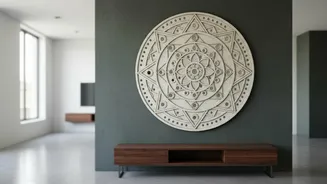
What was once an architectural feature of rural Kutch is now experiencing a remarkable revival in the heart of urban India. The art form's journey into contemporary spaces has been propelled by a renewed appreciation for handcrafted, traditional aesthetics and a desire to connect with cultural roots. Following the Gujarat earthquake in 2001, a renewed focus on preserving the region's heritage crafts brought Lippan Kam into the spotlight, with events like the Rann Utsav further popularising it. Today, the earthy textures and shimmering details of Lippan art provide a striking contrast to the clean lines and minimalist palettes of modern apartments, adding a layer of warmth, history, and personality.
The Modern Adaptation
To suit the modern home, Lippan Kam has gracefully evolved. While traditional artisans still use the age-old techniques, many contemporary artists have adapted the materials to ensure durability and portability. Instead of being sculpted directly onto walls, designs are now often created on MDF boards or wooden panels, allowing them to be sold as portable art pieces. The traditional mud and dung mixture is sometimes replaced with materials like ceramic powder, chalk powder, sawdust, and adhesives to create a lighter, more robust, and odour-free product. This evolution has made the art form more accessible, allowing designers and homeowners to easily incorporate it as a statement piece in living rooms, bedrooms, and even commercial spaces like cafes and hotels.
More Than Just Decoration
The appeal of Lippan art in modern homes goes beyond its visual beauty. In a world of mass-produced decor, each piece of Lippan Kam is a unique, handmade object that carries the imprint of its creator and a rich cultural narrative. It represents a tangible connection to a legacy of sustainable living and community craftsmanship. Bringing a piece of Lippan art into an urban apartment is not just about decorating a wall; it is about celebrating the resilience of traditional artistry, supporting artisan communities, and imbuing a modern space with the timeless soul of the Kutch desert.