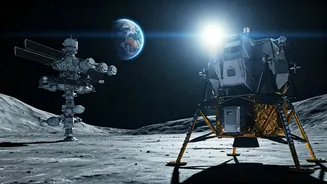









A New Space Race Fueled by Commerce
The global space economy is undergoing a seismic shift. Once a stage for superpower rivalry, space is now a bustling commercial arena, with projections suggesting the market could grow from around $600 billion in 2024 to $1.8 trillion by 2035. [13] This
boom is largely fueled by private companies that are redefining the economics and accessibility of space. [2, 12] Where government-led programs were historically bound by political cycles and immense budgets, private firms operate with a different set of incentives: efficiency, market demand, and profit. This has led to an explosion in launch activity and innovation, from satellite internet constellations to the dawn of space tourism. [7, 9] In this new paradigm, "winning" isn't just about planting a flag; it's about creating sustainable business models, driving down costs, and opening space to a wider range of participants than ever before. [7, 1]
The Reusability Revolution
The single most significant factor in this commercial takeover is reusable rocket technology, pioneered by companies like SpaceX. [5] Traditionally, rockets were single-use vehicles, discarded after each launch—an incredibly expensive approach. [3] Reusable rockets, which can return to Earth, be refurbished, and fly again, fundamentally change the cost equation. [1, 3] SpaceX's Falcon 9, for example, has drastically reduced launch prices, with some estimates suggesting costs as low as $2,700 per kilogram to low Earth orbit, compared to over $10,000 for traditional expendable rockets. [1] This breakthrough has not only made launching satellites more affordable but has also increased the potential frequency of launches, enabling mega-constellations like Starlink and making new industries like in-orbit manufacturing more viable. [1, 7] This innovation has spurred competition, with companies like Blue Origin, Rocket Lab, and others now developing their own reusable systems. [1, 4, 21]
From Bureaucracy to Agility
Private companies often operate with a speed and agility that large government agencies struggle to match. [24] Unburdened by the same level of bureaucratic oversight and political influence that can slow down public sector projects, commercial firms can adopt more of a 'fail fast, learn faster' approach to development. [23, 28] This iterative design process, common in the tech industry, allows for rapid innovation and problem-solving. [24] While government agencies must prioritize extreme risk aversion, especially for high-stakes scientific or human exploration missions, private companies have more flexibility to experiment. [24] This difference in culture and process allows them to shorten development cycles and bring new technologies to market more quickly, giving them a significant competitive edge. [9]
Government as a Customer, Not a Creator
Instead of a simple rivalry, the relationship between government agencies and private companies has evolved into a powerful public-private partnership. [24] Agencies like NASA have strategically shifted from building and operating all their own hardware to becoming anchor customers for commercial services. [14, 17] NASA's Commercial Crew and Cargo programs, which contract companies like SpaceX to ferry astronauts and supplies to the International Space Station (ISS), are prime examples. [16, 27] This model stimulates the private market, reduces costs for the government, and allows NASA to focus its resources on more ambitious, long-term exploration goals, like deep-space science. [14, 26] Recently, NASA even partnered with Relativity Space to build and launch a Mars orbiter, with NASA providing the scientific instruments and the private company handling the rocket and spacecraft. [8, 11, 15]
A Diversifying and Expanding Market
The success of private launch providers has created a ripple effect, enabling a diverse ecosystem of new space-focused businesses. The falling cost of access to orbit has made it economically viable to deploy large constellations of small satellites for global internet (like SpaceX's Starlink) and Earth observation. [2, 18] Meanwhile, companies such as Blue Origin and Virgin Galactic are pioneering the space tourism market. [1, 6] Other firms are focusing on building the infrastructure for a permanent off-world economy, including developing the first commercial space stations to eventually succeed the ISS. [20] This diversification creates a resilient, interconnected market that stimulates further investment and ties the space economy more deeply into the broader global economy. [9]