



A Universe Beyond the Rainbow
To understand the Webb telescope's power, we first need to think about light itself. The vibrant colours we see every day, from the blue of the sky to the red of a rose, are just a tiny fraction of the light that exists. This visible spectrum is part
of a much broader range called the electromagnetic spectrum, which includes everything from high-energy gamma rays and X-rays to low-energy microwaves and radio waves. Nestled between visible light and microwaves is infrared radiation, which we can feel as heat but cannot see. The Webb telescope is specifically designed to be a master of the infrared, capturing wavelengths from the edge of visible red light all the way to the mid-infrared range. This isn't just a niche capability; it's a fundamental tool for modern astronomy.
Infrared Vision: A Cosmic Superpower
Seeing in infrared gives astronomers two incredible advantages. First, it allows them to peer through the immense clouds of cosmic gas and dust that are scattered throughout space. Visible light struggles to get through these dense nebulae, which hide the birth of new stars and planets. Longer-wavelength infrared light, however, can pass through this dust more easily, revealing the stellar nurseries hidden within. The second superpower is the ability to look back in time. The universe has been expanding since the Big Bang, and this expansion stretches the light that travels through it. Light from the very first stars and galaxies, which may have been emitted as visible or ultraviolet light billions of years ago, has been stretched so much during its long journey to us that it now arrives as infrared light. This phenomenon is called 'cosmological redshift', and by detecting this faint, ancient infrared glow, Webb is effectively a time machine, allowing us to witness the dawn of the universe.
Staying Cool for the Ultimate View
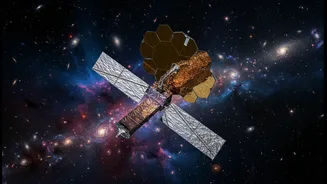
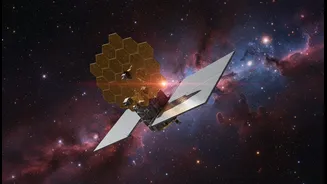
To detect faint infrared signals from the edge of the universe, the Webb telescope itself must be incredibly cold. If it were warm, its own heat would radiate infrared light, blinding its sensitive instruments. To achieve this, Webb employs a brilliant engineering solution. It orbits the Sun 1.5 million kilometres away from Earth at a special spot called the second Lagrange point, or L2. At this point, the gravitational pulls of the Sun and Earth balance out, allowing the telescope to stay in line with the Earth as they both orbit the Sun. This unique position allows its massive, five-layer sunshield, the size of a tennis court, to constantly block heat and light from the Sun, Earth, and Moon simultaneously. This keeps the telescope's mirrors and instruments operating at a frigid -223°C or lower.
Webb's Scientific Eyes
Webb has a suite of four advanced instruments to capture and analyse infrared light. The Near-Infrared Camera (NIRCam) is its primary imager, capturing the shorter infrared wavelengths crucial for seeing the earliest stars and galaxies. The Mid-Infrared Instrument (MIRI) looks at longer infrared wavelengths, which are ideal for seeing through dust to observe newborn stars and detecting distant, redshifted galaxies. The other two instruments, the Near-Infrared Spectrograph (NIRSpec) and the Near-Infrared Imager and Slitless Spectrograph (NIRISS), are spectrographs. Instead of just taking a picture, they spread light out into its constituent wavelengths—like a prism making a rainbow. This allows scientists to determine a celestial object's temperature, mass, and chemical composition.
Painting with Invisible Colours
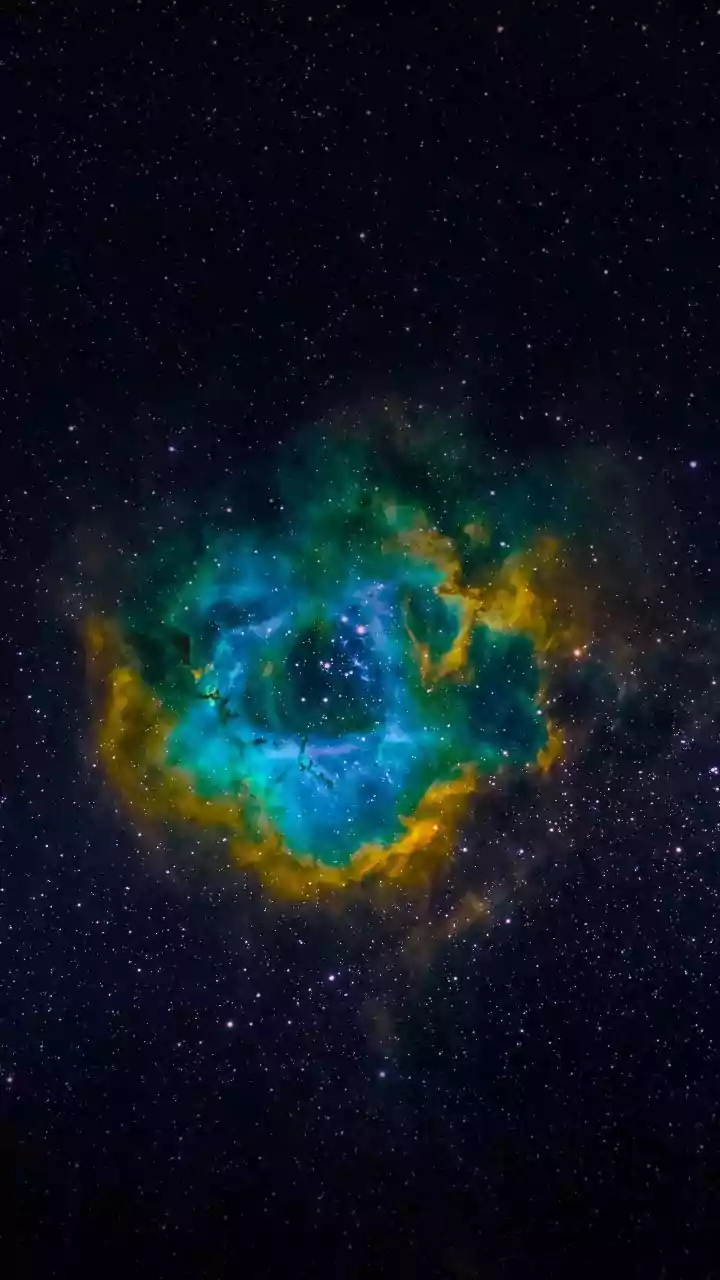
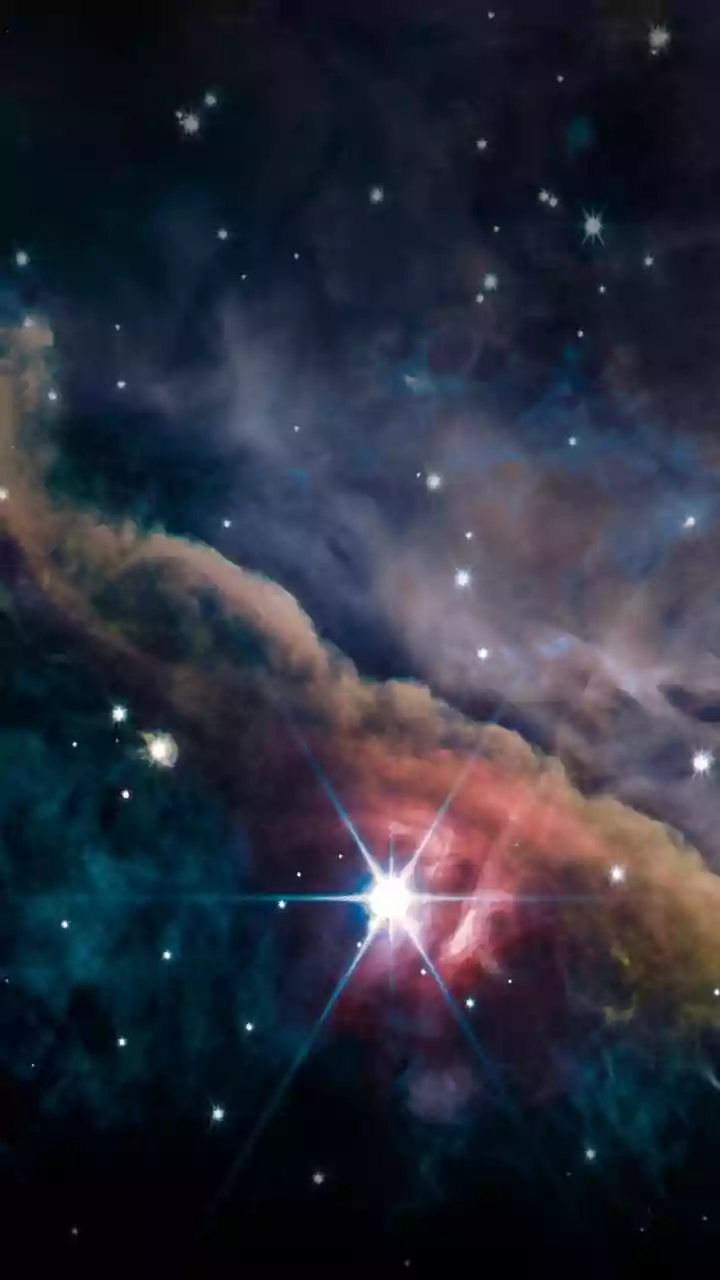
If Webb detects invisible light, how do we get those vibrant, colourful images? The answer is through a process of 'false-colour' imaging. When Webb observes an object, it takes multiple black-and-white images through different filters, each filter capturing a specific slice of the infrared spectrum. Scientists then assign visible colours—typically red, green, and blue—to these different infrared images. Usually, the longest infrared wavelength is assigned red, the shortest is assigned blue, and intermediate wavelengths are assigned green. These coloured layers are then combined to create the final, stunning composite image. While the colours are not what a human eye would see, they are not arbitrary; they represent real physical data and translate the invisible infrared universe into a language our eyes can understand, revealing the structure and composition of distant nebulae and galaxies.