





The Purpose of 'Failure'
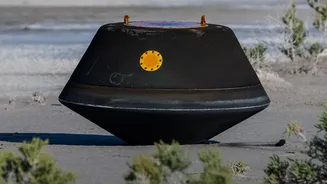
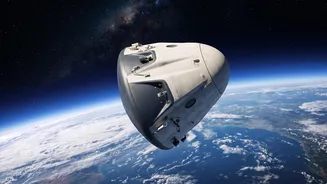
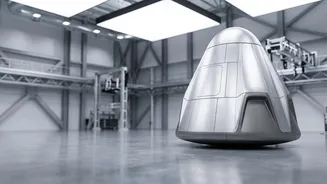
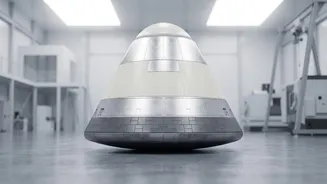
Before Indian astronauts, or 'Gaganauts', ever board the spacecraft, the Indian Space Research Organisation (ISRO) must perfect the Crew Escape System (CES). This system is a lifeboat designed to pull the Crew Module—the capsule carrying the astronauts—away
from the main rocket in case of an emergency during launch or ascent. To ensure this system works under the most stressful conditions, ISRO conducts a series of abort tests, like the Test Vehicle Abort Mission-1 (TV-D1). These tests intentionally simulate failures, such as triggering an abort at transonic speeds (around Mach 1.2), to see how the entire escape sequence performs in the real world, not just in a computer simulation. The goal isn't just to see if it works, but to gather a treasure trove of data on its performance.
Capturing Every Millisecond of Data
During an abort test, which may last only a few minutes, hundreds of sensors embedded within the Test Vehicle, Crew Escape System, and Crew Module record a torrent of information. These sensors track critical parameters like velocity, altitude, orientation, aerodynamic pressure, and the immense G-forces experienced during the violent separation from the launch vehicle. Onboard computers, known as the avionics suite, log this flight data while also beaming it down to ground stations in real-time via telemetry. This data captures the precise moment the escape motors fire, how the module behaves as it is pulled away, the performance of the parachutes as they deploy, and the final splashdown conditions. Every single data point is crucial for the next step.
Decoding the Trajectory Algorithm
At its core, a trajectory algorithm is a complex set of mathematical instructions that tells the Crew Escape System where to go. Its primary job is to calculate the safest and most efficient path to get the Crew Module away from a malfunctioning rocket and onto a course for a safe landing. This isn't a simple, fixed path. The algorithm must make real-time decisions based on the vehicle's altitude, speed, and the nature of the emergency. For example, a pad abort requires a different trajectory than a high-altitude abort to ensure the capsule reaches a sufficient height for parachutes to deploy effectively before landing in a predetermined safe zone, like the sea.
The Refinement Loop: Reality vs. Simulation
Once the Crew Module is safely recovered by the Indian Navy, the real work for the algorithm engineers begins. They meticulously compare the actual flight data from the test with the predictions made by their computer simulations. This is where the refinement happens. Did the module roll slightly more than expected? Was the velocity at parachute deployment a few metres per second off? Did atmospheric conditions affect the trajectory in an unforeseen way? Engineers analyze these deviations to understand why they occurred. They then update the mathematical models within the trajectory algorithm to better reflect the real-world physics it just experienced. This refined algorithm is then run through thousands of new simulations, each one a little more accurate than the last. This iterative loop—test, gather data, compare, refine, and re-simulate—is fundamental to building a robust and reliable system.
More Than Just Code
The data from abort tests doesn't just improve the software; it validates the hardware. The performance of the fast-acting solid motors in the escape system, the separation mechanisms, and the complex sequence of parachute deployments are all scrutinised. For instance, data from the splashdown helps confirm that the parachute system slows the module to a velocity that is safe for the crew. This interplay between hardware performance and software logic is critical. If a motor provides slightly more thrust than modelled, the algorithm must be updated to account for it. This holistic approach ensures that every component of the escape system is understood and its performance is accurately programmed into the guidance logic, leaving as little as possible to chance when human lives are on the line.