
The Universe's Dusty Veil
Understanding how the first galaxies formed has long been a central goal of astronomy. These ancient star cities are the ancestors of everything we see in the cosmos today, including our own Milky Way. The problem is that the early universe was a very messy
place. Vast clouds of cosmic dust and gas, the raw materials for stars and planets, acted like a thick fog, obscuring our view. Telescopes that rely on visible light, like the human eye, are effectively blinded by this dust. It’s like trying to see the details of a bustling city street from a distance through a dense morning haze. You might see some bright lights, but the intricate details of what’s happening remain hidden.
An Infrared Key to the Past
This is where infrared imaging comes in. Infrared light has a longer wavelength than visible light, which gives it a remarkable ability to pass through dense clouds of cosmic dust unhindered. Powerful new observatories, most notably the James Webb Space Telescope (JWST), are designed specifically to see the universe in these infrared wavelengths. JWST is a global collaboration between NASA, the European Space Agency (ESA), and the Canadian Space Agency (CSA). Its incredible sensitivity allows it to act as a time machine. Because light takes time to travel across cosmic distances, when we look at a galaxy billions of light-years away, we are seeing it as it was billions of years ago. By capturing faint infrared light from the edge of the observable universe, JWST gives us a direct view of the cosmic dawn.
Discoveries That Break the Rules
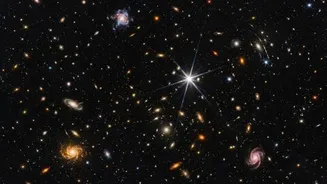
And what astronomers are finding is rewriting the textbooks. For years, models predicted that the first galaxies would be small, chaotic, and relatively simple. However, recent observations from JWST have revealed galaxies in the infant universe that are shockingly massive, bright, and well-structured. Some galaxies seen from when the universe was just a few hundred million years old appear far more mature and chemically developed than scientists thought possible. These discoveries have been so surprising that some have dubbed these objects "universe breakers" because they challenge our fundamental understanding of how quickly large structures could form after the Big Bang. Astronomers are finding complex structures, like stellar bars that channel gas into the galactic center, at a time when they were expected to be just starting to assemble.
Rethinking the Cosmic Story
These findings don't mean that our entire theory of the universe is wrong. Instead, they suggest that the early universe was far more efficient at building galaxies than we gave it credit for. The processes of star formation and element production may have happened faster and more furiously than previous models allowed. To better understand these early processes, astronomers are also using infrared telescopes to study nearby 'dwarf' galaxies. These smaller galaxies have a low concentration of heavy elements, making them excellent modern-day analogues for the pristine conditions of the early universe. By studying how stars form and create dust in these local laboratories, scientists can refine their models and better interpret the incredible data streaming back from the cosmic frontier.