




Peering Through the Cosmic Dust
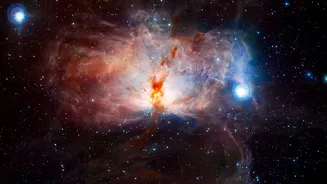
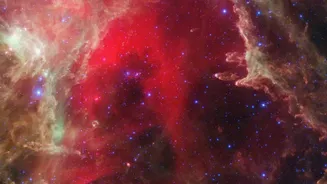
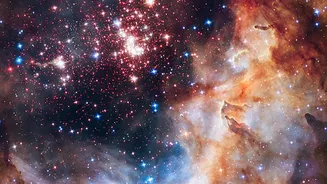
Imagine trying to watch a firefly in the middle of a thick fog. That's the challenge astronomers have faced when trying to observe star formation. Stars are born inside vast, cold, and incredibly dense clouds of gas and dust. These stellar nurseries are so
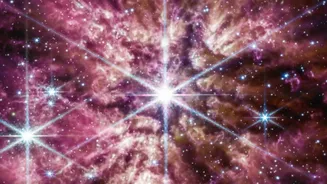
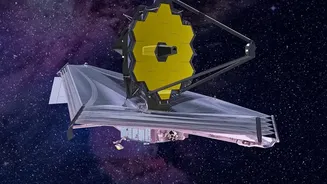
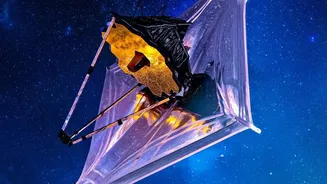
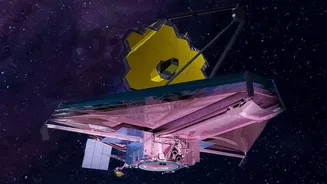
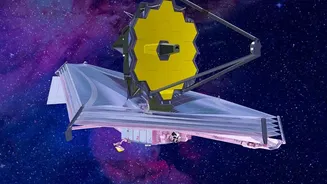
thick that they block almost all visible light, leaving telescopes like Hubble effectively blind to the processes happening deep within. This is where the James Webb Space Telescope (JWST) changes the game. It is designed to see the universe in infrared light, a wavelength that can pass through these dusty cocoons. By capturing this previously hidden light, JWST allows us to witness the very first moments of a star's life.
A Surprise in the Serpens Nebula
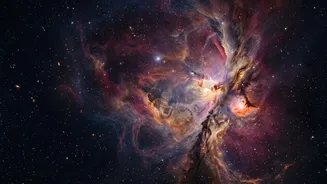
One of the most exciting recent discoveries comes from the Serpens Nebula, a bustling star-forming region located about 1,300 light-years from Earth. It's a cosmic neighbourhood filled with young stars, only about 100,000 years old. When astronomers pointed Webb's powerful Near-InfraRed Camera (NIRCam) at a section of this nebula, they saw something long theorized but never directly observed: a group of baby stars all firing off jets of gas in the exact same direction. These jets, known as protostellar outflows, are a natural part of a star's birth, but seeing them aligned like this was a breathtaking first. NASA described the phenomenon as looking like “sleet pouring down during a storm,” a synchronized cosmic ballet that had been invisible until now.
What the Aligned Jets Reveal
This discovery is more than just a pretty picture; it provides the first direct, visual confirmation of a fundamental theory of star formation. Astronomers have long assumed that when a giant cloud of gas and dust begins to collapse under its own gravity, it starts to spin. As this cloud fragments into individual cores that will each become a star, those newborn stars should inherit the parent cloud's original spin. This means they should all rotate in the same direction and, consequently, their outflows should be aligned. For decades, this was a cornerstone of star formation models, but there was no direct proof. With this single image from Webb, what was once an assumption is now an observed reality. As principal investigator Klaus Pontoppidan of NASA's Jet Propulsion Laboratory noted, this phenomenon has “not been seen so directly before.”
The Power of Infrared Precision
Before JWST, the objects responsible for these jets were either completely invisible or appeared as indistinct blobs in images from other telescopes. But Webb's exquisite resolution and sensitivity cut through the haze. The jets appear in the new images as bright, clumpy red streaks. This red glow isn't fire; it's the signature of shockwaves created when the high-speed gas from the baby star slams into the colder, surrounding material of the nebula. By studying the shape, direction, and composition of these jets, scientists can now piece together the history of a star's growth. It allows them to understand how stars gather mass, how they interact with their environment, and how their powerful outflows might influence the birth of other stars and planets nearby.