


A Legacy of Daring Exploration
The Japan Aerospace Exploration Agency (JAXA) has firmly established itself as a global leader in asteroid exploration. Its legacy began with Hayabusa, which, despite numerous challenges, became the first mission to return samples from an asteroid in 2010.
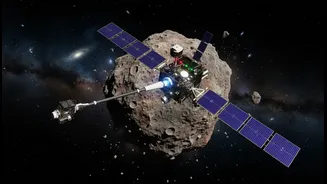
Its successor, Hayabusa2, raised the bar significantly. Launched in 2014, it rendezvoused with the asteroid Ryugu, deployed rovers, and even created an artificial crater to collect subsurface samples. In December 2020, it successfully delivered these precious samples—containing organic molecules and water-bearing minerals—back to Earth, offering unprecedented insights into the building blocks of our solar system. But for the resilient Hayabusa2 probe, that was not the end. With half its fuel remaining, JAXA approved an extended mission, sending the spacecraft back into deep space for a new set of challenges.
The Torifune Encounter
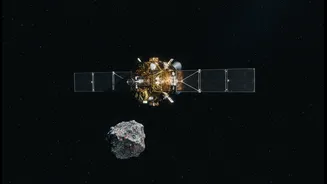
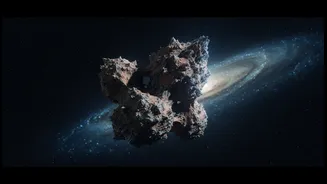
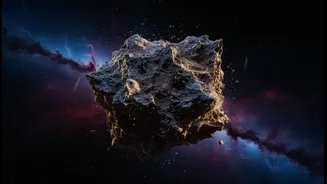
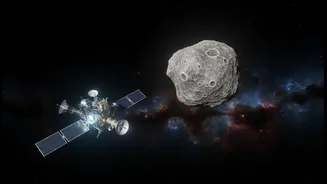
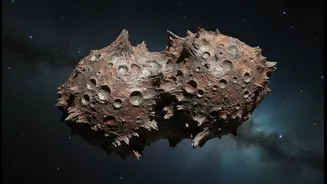
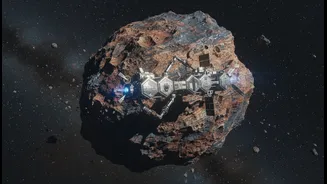
The first major objective of this extended mission was the flyby of asteroid 98943 Torifune on July 5, 2026. Unlike the slow, deliberate rendezvous with Ryugu, this was a high-speed encounter. Hayabusa2 passed the 450-meter-wide asteroid at a blistering relative speed of about 5 kilometers per second. The flyby was an immense technical challenge, as the spacecraft was not originally designed for such a rapid intercept. JAXA engineers pushed the probe to its limits, achieving a remarkably close pass of about 800 meters from the asteroid's center. Images sent back revealed Torifune's surprising nature: it is a 'contact binary,' appearing like two separate asteroids that have gently fused together.
A Test for Planetary Defense
The Torifune flyby was more than just a scientific sightseeing tour; it was a crucial test for planetary defense. One of the primary goals was to demonstrate high-precision autonomous navigation—the ability for the spacecraft to guide itself to a fast-moving target without real-time human intervention. Mastering this technology is vital for future missions that might need to intercept a potentially hazardous asteroid. By successfully tracking and imaging Torifune at high speed, Hayabusa2 has provided critical data for developing 'kinetic impactor' strategies, where a probe is intentionally crashed into an asteroid to alter its course. This successful maneuver demonstrates that Japan has the technological capability to contribute significantly to global efforts to protect Earth from celestial threats.
What's Next for Hayabusa2?
The journey for this celebrated probe is far from over. After its encounter with Torifune, Hayabusa2 will perform a series of Earth swing-bys in 2027 and 2028, using our planet's gravity to slingshot itself towards its final, most ambitious target. In July 2031, the spacecraft is scheduled to rendezvous with an incredibly small, fast-spinning asteroid named 1998 KY26. Estimated to be only about 30 meters in diameter, it would be the first time a spacecraft has ever explored such a small object up close. This final phase of the extended mission will provide invaluable information on a class of asteroids that are difficult to detect from Earth but could still pose a threat. Hayabusa2 continues to transform from a sample-return hero into a versatile deep-space explorer, pushing the frontiers of science and engineering with every kilometer it travels.