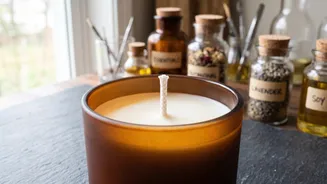







Creating homemade scented candles is a rewarding way to personalise your space. The true magic lies in selecting a fragrance that transforms your house into a home, but where do you begin? This guide will help you navigate the world of scents.
Understanding Scent Families
Before you
start blending, it's helpful to understand the basic fragrance categories, often called 'families'. Each family has a distinct character. Floral scents, like rose and jasmine, create a soft, delicate mood. Woody scents, such as sandalwood and cedar, offer a warm, grounding, and sophisticated atmosphere, perfect for cosy spaces. Citrus scents like lemon and bergamot are bright, fresh, and energising, ideal for kitchens and living areas. Fresh scents might remind you of clean linen or a cool sea breeze, bringing a sense of cleanliness. Finally, spicy and gourmand scents like cinnamon, vanilla, or coffee create a rich, comforting, and often nostalgic feeling. Knowing these families helps you narrow down your choices based on the feeling you want to create.
The Art of Fragrance Notes
A well-made scent is like a symphony, composed of different layers called notes that unfold over time. Top notes are what you smell first; they are light, fresh, and evaporate quickly, usually within 15 to 30 minutes. Think of citrus, mint, or light herbs. After the top notes fade, you experience the middle or 'heart' notes. These form the main body of the fragrance and can last for a couple of hours. This is often where florals and spices like cinnamon or jasmine shine. Finally, the base notes emerge. These are the deep, rich scents that anchor the fragrance and linger the longest, such as vanilla, musk, and sandalwood. A balanced candle uses all three to create a complex and evolving aroma.
Scenting Your Home Room by Room
Matching the scent to the room's purpose can dramatically enhance your home's ambiance. For the living room, aim for warm and welcoming scents that encourage connection, like amber, soft woods, or gentle florals. In the kitchen, it's best to use clean, crisp fragrances like citrus or herbs (such as sage and grapefruit) that can neutralize cooking odours without clashing with them. The bedroom is a sanctuary for rest, so calming and soothing scents are ideal. Lavender, chamomile, and soft vanilla are excellent choices to promote relaxation and sleep. For a home office, consider scents that aid focus and alertness, such as rosemary, mint, or even cinnamon, which is said to improve concentration.
Essential Oils vs. Fragrance Oils
When making candles, you'll choose between essential oils and fragrance oils. Essential oils are natural compounds extracted directly from plants. Fragrance oils are synthetic blends created in a lab, specifically designed for performance in products like candles. While essential oils are natural, they can be volatile and lose their potency or change their scent when exposed to the high heat of melted wax. Fragrance oils, on the other hand, are engineered to be stable in heat, providing a stronger and more consistent 'scent throw' — the term for how well a candle's fragrance fills a room. For beginners, fragrance oils are often easier to work with and offer a wider, more reliable range of scents.
Tips for Blending Like a Pro
Blending your own unique scents is the most creative part of candle making. A good rule of thumb is to start simple, using just two or three oils. Try combining scents from neighbouring families on the fragrance wheel, like a citrus with a floral, or a woody scent with a spicy one. A classic blending structure follows a 30% - $50% - $20$ ratio (30% top notes (middle notes), $50%$ middle notes (and $20%$ base notes), though this is just a starting point. Before committing to a full candle (you can test your blend by dipping separate paper blotter strips or cotton swabs into each oil and holding them together to get an impression of the combined aroma). Keep a journal of your successful recipes so you can recreate your signature scents later.