
Get ready, India. The largest and most powerful rocket ever built, SpaceX's Starship, is preparing for another ambitious flight that will bring it into the skies near the subcontinent on its journey around the Earth. Here's what to know.
What is Starship?
Imagine a vehicle
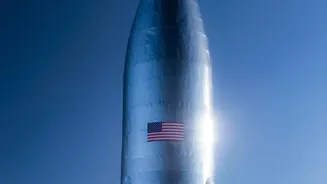
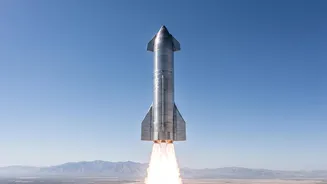
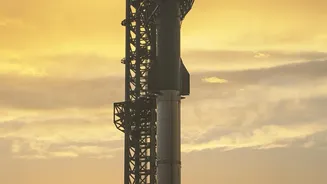
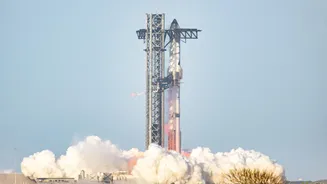
so powerful it could redefine humanity's relationship with space. That's the promise of Starship. Developed by Elon Musk's SpaceX, it is the world's first fully reusable transportation system designed for interplanetary travel. Standing a colossal 120 meters tall when stacked on its 'Super Heavy' booster, it's the tallest rocket ever built. Its main purpose is to drastically lower the cost of access to space by being able to fly, land, and fly again, much like a commercial airplane. The ultimate goal is ambitious: to carry crews and cargo to the Moon, Mars, and beyond, with Musk envisioning a fleet of a thousand Starships to build a self-sustaining city on Mars. It's designed to carry up to 100 people or more than 100 metric tonnes of cargo to low Earth orbit.
The Upcoming Flight and Its Fiery Path
The next major test flight, Flight 15, is slated to launch from SpaceX's Starbase facility in Texas. Like several of its recent predecessors, the mission plan involves the Starship upper stage reaching a near-orbital velocity and travelling across the globe. The flight path is designed for the spacecraft to perform a controlled reentry and splashdown in the Indian Ocean. This trajectory, which brings the vehicle over the region, has been chosen for safety reasons. For a test flight that doesn't aim for a full, stable orbit, a splashdown in the vast expanse of the Indian Ocean provides a huge margin for error, far from populated landmasses. While a direct overhead pass of the Indian mainland is unlikely, its orbital path will bring it into the wider region, offering potential, albeit distant, viewing opportunities.
Why This Is a Game-Changer
The significance of the Starship program cannot be overstated. For decades, rockets were single-use machines; incredibly expensive, complex hardware would be discarded after just one flight. SpaceX’s Falcon 9 rocket began to change this with its reusable first-stage booster. Starship aims to perfect this model by making both its massive booster and the upper-stage spacecraft fully and rapidly reusable. This is the 'holy grail' of rocketry. Achieving this would slash the cost of launching anything—or anyone—into space by orders of magnitude. It would unlock the potential for mega-constellations of satellites, large-scale scientific missions, and eventually, the construction of bases on the Moon and Mars as part of programs like NASA's Artemis missions. Each successful test flight, even those that end in a planned splashdown, gathers crucial data that brings this future one step closer.
What This Means for India's Space Ambitions
As Starship streaks across the sky, it casts a long shadow over the global space industry, and India is watching closely. The Indian Space Research Organisation (ISRO) is a world-class agency with a long history of efficient and groundbreaking missions. It is also actively developing its own reusable launch vehicle technologies. ISRO has made significant progress with its winged Reusable Launch Vehicle (RLV) demonstrator, named 'Pushpak', successfully completing a series of autonomous landing experiments. The organisation is also developing a partially reusable Next Generation Launch Vehicle (NGLV) designed to lower launch costs for national and commercial missions, including supporting the future Bharatiya Antariksh Station. The rapid progress of SpaceX's Starship presents both a competitive challenge and a potential opportunity. It accelerates the timeline for the entire industry, pushing all players to innovate faster. For India, it underscores the importance of its own self-reliant reusable technology programs while also opening the door for future international collaborations in this new era of commercialised, accessible space.