



The Universe's Invisible Glue
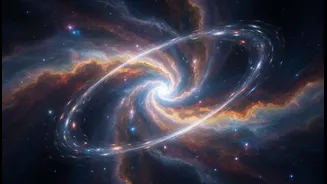
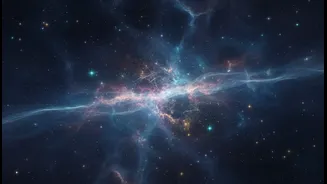
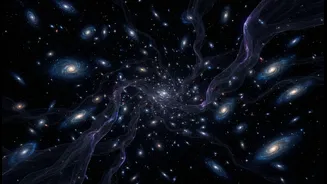
First, let's recap the biggest mystery in modern physics. We know dark matter exists not because we can see it, but because we can see its effects. It's the invisible 'cosmic glue' whose immense gravity keeps galaxies from flying apart and shapes the large-scale
structure of the cosmos. For years, the prevailing theory was that dark matter is a new type of slow-moving, massive particle that just doesn't interact with light. But despite decades of building hyper-sensitive detectors deep underground, we haven't found it. This lack of direct detection has led physicists to think more creatively, and more strangely.
Thinking Outside Our Four Dimensions
This is where things get interesting. The idea of extra dimensions isn't just science fiction; it’s been a part of theoretical physics for over a century, first proposed as a way to unify gravity and electromagnetism. We experience three spatial dimensions (length, width, height) and one of time. But what if there are more, curled up so small we can’t perceive them? Some theories, like the 'warped extra dimension' (WED) model, propose that our four-dimensional universe is just a membrane, or 'brane,' floating within a larger, five-dimensional space. This extra dimension wouldn't be something we could travel into, but it could be a place where other particles and forces operate.
A New Address for Dark Matter
The latest theories connect these two puzzles: dark matter and extra dimensions. One new proposal from physicists suggests that dark matter particles might exist primarily in this hidden fifth dimension. In this scenario, particles that carry the force of gravity, called gravitons, can travel between our dimension and the hidden one. These gravitons, as they leak into and out of the fifth dimension, could manifest in our universe as the missing mass we call dark matter. A recent theory published by researchers at the University of Sheffield goes a step further, proposing that the specific geometry of this fifth dimension could cause dark matter particles to 'resonate', making them interact strongly in the early universe to form the structures we see today, while being almost inert and invisible now.
The Hunt for Testable Predictions
A theory is only as good as its predictions. Proposing a fifth dimension is easy; proving it is hard. But these new ideas aren't just wild speculation; they offer tangible, testable clues. For example, if gravity can leak into another dimension, it might affect the signals from gravitational waves—the ripples in spacetime from colliding black holes. Detecting a gravitational wave that seems weaker than it should be for its distance could be a sign that energy was lost to another dimension. Other tests involve particle colliders like the Large Hadron Collider. Smashing particles together at immense energies could produce 'Kaluza-Klein' particles—heavier versions of normal particles that get some of their mass from vibrating in an extra dimension. Finding a tower of these particles at specific energy levels would be smoking-gun evidence.
Why Independent Evidence Is Crucial
One strange signal in one experiment isn't enough to rewrite the laws of physics. The scientific process demands independent evidence and corroboration. If a gravitational wave observatory sees a faint signal, a particle collider needs to find a corresponding heavy particle, or a telescope needs to spot an unusual cosmic microwave background pattern predicted by the theory. We've seen this before with other potential discoveries. The Muon g-2 experiment, for example, found muons behaving in ways not predicted by the standard model, a hint of new physics that is now being intensely scrutinized by other experiments around the world. Any claim as extraordinary as a fifth dimension will require an equally extraordinary level of proof from multiple, unrelated sources before it can be accepted.