


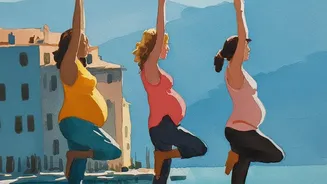
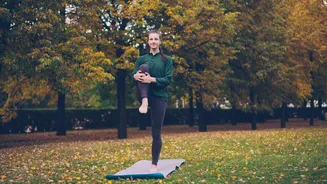
The Foundation: Revisiting Tree Pose (Vrksasana)
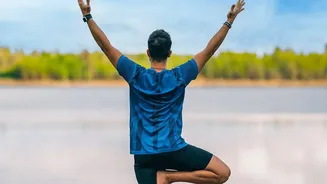
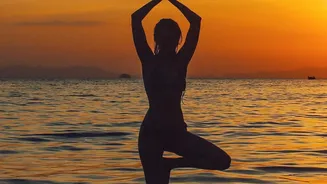
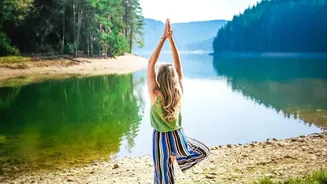
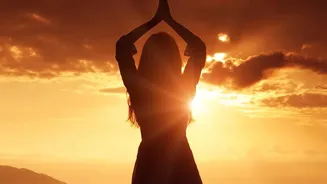
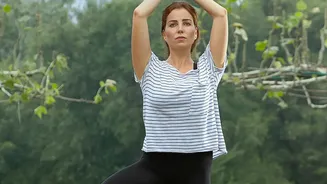
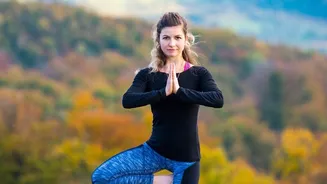
Before you can fly, you need strong roots. Tree Pose, or Vrksasana, is a foundational balancing posture that teaches us stability from the ground up. The primary action involves standing on one leg while placing the sole of the other foot on the inner
thigh or calf of the standing leg—never directly on the knee joint. The goal is to create a sense of groundedness through the standing foot while lengthening the spine. Key alignment points include keeping both hip bones pointing forward, engaging the core, and pressing the raised foot into the thigh as the thigh presses back. This creates a dynamic tension that helps stabilize the pelvis. Your gaze, or 'drishti', should be fixed on a non-moving point in front of you to aid concentration. It’s a pose that builds strength in the legs and core while cultivating a calm, steady mind.
The Expansion: Understanding Half-Moon (Ardha Chandrasana)
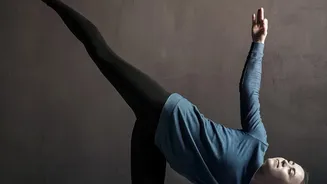
If Tree Pose is about vertical stability, Half-Moon Pose, or Ardha Chandrasana, is about horizontal expansion. This challenging posture also involves balancing on one leg, but here the torso hinges forward to become parallel with the floor, with one hand on the ground (or a block) for support. The other leg extends back, parallel to the floor, while the corresponding arm reaches toward the sky. The key is to open and stack the hips and shoulders, creating a feeling of spreading out in all directions, just like a half moon. This pose strengthens the ankles, legs, abdomen, and glutes while stretching the hamstrings, chest, and shoulders. It demands significant coordination and spatial awareness, making it a powerful tool for improving focus.
Why Blend These Poses?
Combining elements of Tree and Half-Moon creates a dynamic flow that challenges your balance in new ways. Transitioning from the upright, externally rotated hip of Tree Pose to the hinged, open-hip posture of Half-Moon forces your stabilizing muscles to adapt constantly. It’s a physical conversation between grounding and expanding. This practice improves proprioception—your body's ability to sense its position in space—and enhances mental determination. When you learn to maintain your balance through tricky transitions on the mat, you build resilience that can be carried into daily life. Furthermore, this blend offers a creative way to deepen your hip-opening and core-strengthening practice within a single, fluid sequence.
A Step-By-Step Guide to Flowing Tree
One of the most accessible and rewarding variations is a 'Flowing Tree' that moves toward a Half-Moon shape. 1. Begin in a strong Tree Pose on your right leg, with your left foot on your inner right thigh and hands at your heart. Take several breaths to feel stable. 2. Keep your gaze fixed. Begin to hinge forward at your hips, maintaining a long spine. Your torso will move toward being parallel with the floor. 3. As you hinge, allow your hands to come down toward the floor. Place your right hand on a block or the floor about a foot in front of your right foot. 4. Simultaneously, release your left foot from your inner thigh and extend it straight back behind you, aiming for hip height. 5. Start to open your torso to the left, stacking your left hip over your right. Extend your left arm to the sky, coming into Half-Moon Pose. 6. Hold for a few breaths, then with control, reverse the sequence to return to Tree Pose. Remember to repeat on the other side.
Exploring Sugarcane Pose
For a deeper variation, you can explore Ardha Chandra Chapasana, or Sugarcane Pose. This is an advanced version of Half-Moon. From a stable Half-Moon Pose, you bend the knee of your lifted leg, bringing your heel toward your glute. Then, reach back with your top hand to catch your foot or ankle. This adds an intense quadriceps stretch and a backbend to the posture, creating a beautiful 'bow' shape. It requires significant openness in the shoulders and quadriceps, as well as a very steady balance. It's a challenging and heart-opening expression of the Half-Moon shape.
Tips for Stability and Safety
Balance is a journey, not a destination. To ensure a safe practice, keep these tips in mind. First, always use a yoga block under your bottom hand in Half-Moon variations. This brings the floor closer to you, preventing you from collapsing and compromising your alignment. Maintain a micro-bend in your standing knee to avoid hyperextension. Engage your core muscles throughout the pose; this is crucial for protecting your lower back and maintaining stability. If you feel wobbly, try practicing near a wall for support, allowing you to focus on alignment without the fear of falling. Most importantly, embrace the wobbles. Falling is part of the learning process. The real yoga is in how you get back up and try again with patience.