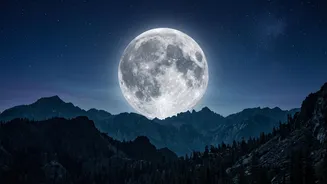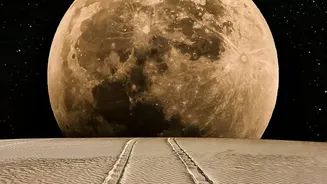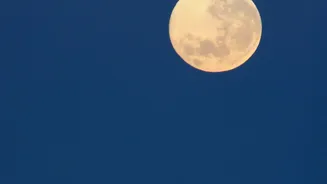



You’ve seen it: a colossal, golden moon rising over the horizon, looking so close you could almost touch it. But is it really bigger? The surprising answer is no, and you can prove it with a simple ruler and a little bit of science.
The Illusion We All Fall For
It’s one of the most
stunning sights in the night sky—a massive harvest moon or a blood-orange supermoon climbing above the distant treeline or cityscape. It feels dramatic, imposing, and undeniably enormous. Hours later, you might glance up to see that same moon high in the sky, looking like a small, pale coin against a black velvet cloth. Your eyes aren't playing a casual trick on you; they're participating in one of the oldest and most powerful optical illusions known to humanity. It’s called the Moon Illusion, and it has puzzled thinkers from Aristotle to modern-day NASA scientists. The common assumption is that the Earth’s atmosphere must be acting like a lens, magnifying the moon when it's low. But that theory is wrong. In fact, atmospheric refraction slightly squashes the moon's appearance, it doesn't enlarge it. The truth is far more fascinating: the moon doesn't change size at all. The entire spectacle happens inside your head.
Your Brain Is The Culprit
The Moon Illusion isn't a physical phenomenon but a perceptual one. Your brain, in its endless effort to make sense of the world, is the real artist behind this masterpiece of deception. The leading explanation is known as the Apparent Distance Hypothesis. This theory suggests that our brains use clues on the horizon to judge distance and, by extension, size. When the moon is low in the sky, you see it in context with trees, buildings, and mountains. Your brain knows those objects are far away, so it concludes that the moon, which appears behind them, must be incredibly distant—and therefore, absolutely massive to appear as large as it does. When the moon is high in the sky, it floats in the vast, empty expanse of space. With no reference points to give it scale, your brain perceives the sky as a closer, flattened dome overhead. Against this featureless backdrop, the moon appears smaller because your brain isn't getting any environmental cues telling it otherwise.
The Ponzo Illusion on a Cosmic Scale
A great way to understand this is through a classic psychological trick called the Ponzo Illusion. Imagine two identical horizontal lines drawn between a pair of converging lines, like railroad tracks stretching into the distance. The line that's 'further away' (higher up, where the tracks are closer together) will look longer than the one that's 'closer'. They are the same length, but your brain automatically adjusts for the perceived distance, inflating the size of the more distant line. The Moon Illusion is essentially the Ponzo Illusion on a grand, celestial scale. The landscape provides the converging 'tracks', and the moon is the object your brain resizes based on where it sits in the frame. This automatic process, called size constancy, is what helps you recognize a car as being car-sized whether it's 10 feet away or a mile down the road. Most of the time it works perfectly, but with the moon, it creates a beautiful, persistent illusion.
The DIY Ruler Test: Prove It Yourself
This all might sound like a neat theory, but you don't have to take science's word for it. You can debunk the illusion yourself with a simple ruler or even just your thumb. The next time you see a seemingly giant moon on the horizon, hold a ruler at full arm’s length and measure its diameter. A standard pencil eraser or your pinky fingernail held at arm's length also works perfectly. You might find it’s only a quarter-inch wide, or smaller than your nail. Now, wait a few hours until that same moon has risen high into the sky and appears to have 'shrunk'. Go back outside and repeat the measurement from the exact same arm's length. You’ll discover that it measures the exact same size. The ruler provides an objective measurement that your brain’s contextual processing can't argue with, proving that the moon's angular size in the sky remains constant. Taking a photo with the same zoom settings at both points will also confirm it.