





Your Balcony Stargazing Toolkit
Getting started is simpler than you think. The most important tool is patience. Find a comfortable chair, switch off your balcony lights, and give your eyes about 15 to 20 minutes to adjust to the darkness; this will dramatically increase the number of stars
you can see. A good stargazing app on your phone can act as your interactive map of the heavens, helping you identify planets and constellations just by pointing your device at them. Finally, while not essential, a pair of basic binoculars can enhance your view of the Moon's craters or reveal the moons of Jupiter, transforming bright dots into fascinating worlds.
Saturn: The Star of the Show
This October, the planet Saturn is the main event. On October 4, it reaches 'opposition', which means Earth passes directly between Saturn and the Sun. This makes it appear at its brightest and largest for the year, visible all night long. For observers in India, Saturn will rise around sunset and be visible throughout the night. While its famous rings require a small telescope to be seen clearly, the planet itself will be a brilliant, steady, yellowish point of light. Look for it in the constellation Pisces; it will be one of the brightest objects in that part of the sky. The weeks surrounding October 4 are also excellent for viewing.
Two Meteor Showers to Catch
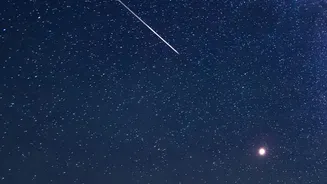
October hosts two meteor showers. First are the Draconids, peaking on the night of October 8-9. This is a minor shower, but viewing conditions are excellent in 2026 as the peak coincides with a nearly new moon, making for dark skies. The best time to watch is in the early evening, just after full darkness sets in. Later in the month, the famous Orionids peak on the night of October 21-22. These fast, bright meteors are debris from Halley's Comet. You can expect to see around 15-20 meteors per hour in a dark sky. A bright Moon will interfere in the evening, but it sets a few hours before dawn, making the early morning of October 22 the best window to catch the show.
A Dance of Planets and the Moon
Keep an eye out for beautiful pairings in the sky. In the pre-dawn hours of October 5, the waning crescent Moon will appear very close to the reddish planet Mars. The next morning, October 6, the Moon will have moved to sit near the brilliant giant planet Jupiter. Jupiter is unmistakable due to its brightness and will be visible in the early morning sky throughout the month. Mars, with its distinct orange-red hue, is also an early morning target. While Venus and Mercury are also in the sky, they are very low on the horizon around sunset and can be difficult for beginners to spot.
Constellations for Autumn Nights
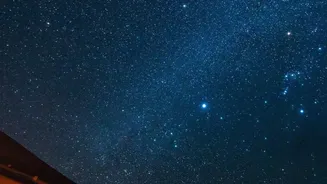
Finding constellations is a rewarding part of skywatching. This month, look for the 'Great Square of Pegasus' high in the evening sky after dark. This giant box shape is a landmark of the autumn sky. Another easy-to-spot pattern is Cassiopeia, which looks like a large 'W' or 'M' depending on its orientation. As the night progresses, one of the most famous constellations, Orion the Hunter, will begin to rise in the east, heralding the coming winter skies. It’s recognizable by its three bright stars in a straight line forming Orion's belt. You can also spot the Pleiades star cluster, known in India as Krittika, which looks like a tiny, shimmering question mark or a small clutch of stars.
The Ever-Changing Moon
Don't underestimate the Moon as a target. Its appearance changes nightly. This month, the Full Moon, known as the Hunter's Moon, falls on October 26. Because it peaks during the day in India, the best time to enjoy its beauty will be at moonrise on the evening of October 25, when it will appear large and golden on the horizon. For observing craters and mountains, the best time is not during the full moon but when it is in its quarter phases. The shadows along the terminator—the line between the lit and dark parts—throw its surface features into stunning relief.