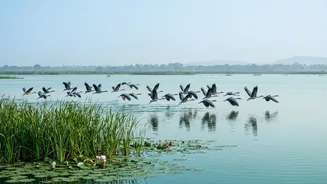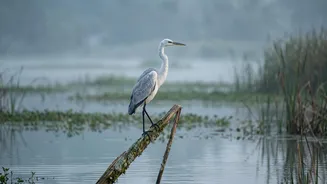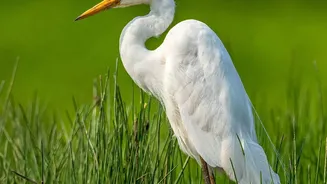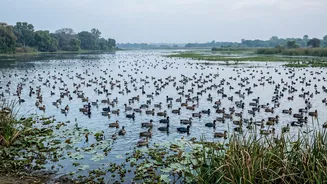





As winter approaches, the skies over India come alive. The arrival of millions of migratory birds is a breathtaking spectacle and a powerful reminder of India's vital position as a custodian of global biodiversity through its network of wetlands.
A Spectacle in the Skies
Across
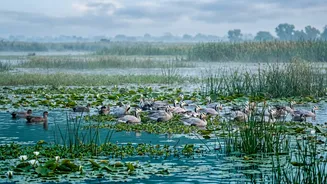
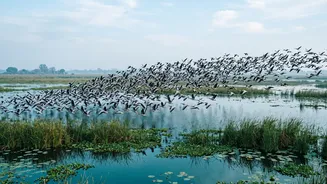
the country, a timeless natural event is unfolding. From the vast expanses of Chilika Lake in Odisha to the famed marshes of Keoladeo National Park in Rajasthan, the first flocks of winter migratory birds have begun to arrive. Species like the Northern Pintail, Gadwall, Eurasian Wigeon, and the iconic Bar-headed Goose have completed arduous journeys from as far as Siberia and Central Asia to settle in India's relatively warmer climes. This annual migration, a phenomenon driven by instinct and survival, transforms India's lakes, rivers, and coastal mudflats into bustling, noisy hubs of avian life, drawing nature enthusiasts and signaling a change of seasons. While birds have started arriving in some areas as early as September and October, November is typically when their numbers swell, marking the true beginning of this magnificent natural display.
India: A Vital Stop on a Global Superhighway
These birds are not just tourists; they are travelers on the Central Asian Flyway (CAF), a major aerial route that spans 30 countries from the Arctic to the Indian Ocean. India's geographic position makes it one of the most critical wintering grounds on this flyway, with its diverse habitats providing essential stopover and refuge sites. Over 90% of the bird species that use the CAF depend on Indian wetlands at some point in their life cycle. From the high-altitude lakes of the Himalayas to the coastal lagoons in the south, these wetlands are not just optional rest stops but essential infrastructure for survival, allowing birds to feed, rest, and build strength. The loss or degradation of even one of these sites can have a ripple effect across the entire migratory route, impacting bird populations thousands of kilometers away.
Our Ecological Kidneys
The importance of these wetlands extends far beyond providing a winter home for birds. Often referred to as 'Earth's kidneys', wetlands perform invaluable ecological services. They act as natural filters, purifying our water by trapping pollutants and sediment. They are crucial for groundwater recharge, flood control, and shoreline protection. Furthermore, they are massive carbon sinks, playing a vital role in climate change mitigation. The health of wetlands is directly linked to the livelihoods of millions of people who depend on them for fishing, agriculture, and tourism. In essence, the arrival of migratory birds is an indicator of the health of ecosystems that are fundamental to our own environmental and economic security.
Fragile Sanctuaries Under Pressure
Despite their importance, India's wetlands are under severe threat. Nearly 40% of the country's wetlands have been lost in the last three decades, and many of those that remain are degraded. The primary culprits are rapid urbanisation, pollution from industrial and domestic waste, agricultural runoff, and encroachment for construction. Invasive alien species, both plant and animal, are another major threat, outcompeting native species and disrupting the delicate ecological balance. Climate change adds another layer of complexity, with erratic rainfall, rising temperatures, and changing water levels altering these sensitive habitats, sometimes causing birds to leave earlier than usual. The drying of wetlands, like the recent concerns over Najafgarh, can devastate bird populations that rely on them.
A Shared Path to Conservation
Recognizing the threats, India has bolstered its conservation efforts. The country now has the largest network of Ramsar Sites (wetlands of international importance) in Asia. Initiatives like the National Plan for Conservation of Aquatic Ecosystems (NPCA) and the Wetlands (Conservation and Management) Rules, 2017, provide a framework for protection. India has also taken a leadership role in the conservation of the Central Asian Flyway, launching a national action plan to protect migratory birds and their habitats. Conservation is increasingly viewed as a shared responsibility, with 'Save Wetlands' campaigns and missions like 'Sahbhagita' aiming to involve local communities, who are often the most effective stewards of these ecosystems.