









The Tradition of the Red Ball
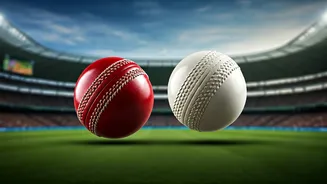
For centuries, cricket was played with only a red ball. Developed in the 1700s, its colour was a simple matter of practicality. In Test cricket, where players wear all-white kits, the red ball provides a strong visual contrast against the players' clothing
and the green outfield, especially during daylight hours. It is made from leather that is dyed red and then polished. This traditional process gives the red ball its famed durability, allowing it to last for the 80 overs required in a Test match innings before a new one can be taken. This slow deterioration is key to the tactics of Test cricket; as the ball ages, one side is polished while the other becomes rough, enabling the art of 'reverse swing'—a skill that is a hallmark of the long format.
The White Ball Revolution
The white ball is a much more recent innovation, born out of a commercial revolution in the 1970s. When Australian media mogul Kerry Packer founded World Series Cricket in 1977, he introduced day-night matches played under floodlights to attract larger television audiences. Under yellow floodlights, the red ball became difficult to see, appearing brownish and blending in with the pitch. The solution was a white ball, which offered far better visibility for players, umpires, and viewers at home. This change was paired with another iconic shift: teams began wearing colourful jerseys instead of the traditional whites, ensuring the ball remained easy to spot against the players' kits.
It’s More Than Just a Different Colour
While manufacturers often state the core construction is the same—a cork centre wrapped in string and covered in leather—the finishing process creates significant differences. Red balls are dyed, and a layer of polish is applied. White balls, however, are coated with a hard-wearing polyurethane paint to keep them clean and visible for longer. This coating makes the white ball's surface smoother and harder initially. As a result, white balls tend to swing more than red ones in the early overs of an innings. However, this painted surface deteriorates faster. The shine is harder to maintain, and the ball gets softer more quickly, which is why in ODIs, two new white balls have been used per innings since 2012—one from each end.
Enter the Pink Ball: A Modern Compromise
With the desire to bring the five-day format to primetime audiences, day-night Test cricket presented a new problem. A red ball is hard to see under lights, but a white ball couldn't be used because it would clash with the players' white clothing and wouldn't last the 80-over innings. After years of research and testing colours like orange and yellow, the pink ball was developed as the solution. Coated with a special fluorescent pigment, it glows under modern LED floodlights, making it visible at night. It's stitched with a black thread for better definition and has a finish designed to be more durable than the white ball's, yet more visible than the red one's, creating a balance for the longest format of the game.