
A Speck in the Darkness
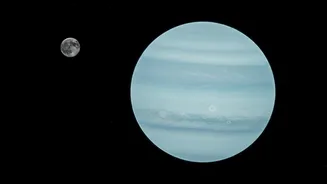
Astronomers have added a new member to Uranus's family of moons, bringing the total count to 28. This newcomer, S/2023 U1, is the first to be found orbiting the ice giant in over two decades. It is incredibly small, estimated to be only about 8 kilometres
in diameter, making it one of the faintest moons ever detected around the planet using ground-based telescopes. For perspective, it is smaller than Mars's moon Deimos. Its orbit takes approximately 680 Earth days to complete, a long journey for such a tiny object in the cold, outer reaches of the solar system. The discovery itself is a testament to the power of modern astronomical tools and techniques.
The Technology Behind the Find
Finding an object this small and faint from billions of kilometres away is a monumental challenge. The discovery was made by astronomer Scott S. Sheppard using the powerful 6.5-meter Magellan Telescopes at Las Campanas Observatory in Chile. It required a special technique where multiple long-exposure images, taken in late 2023, were stacked and processed to reveal objects moving with Uranus against the backdrop of distant stars. This method allowed the faint light of the moon to become visible. After its initial detection, astronomers were even able to find traces of the moon in older images from as far back as 2021, which helped confirm its orbit and existence.
A Cosmic 'Shepherd' at Work
The main reason for the intense scientific interest in S/2023 U1 is its potential role as a "shepherd moon." Shepherd moons are small satellites that orbit near the edges of a planet's rings, and their gravitational pull helps to keep the ring particles contained in a narrow, well-defined band. They essentially "herd" the ring material, preventing it from spreading out and dissipating. Uranus already has known shepherd moons, like Cordelia and Ophelia, which maintain its bright epsilon ring. The location of S/2023 U1 suggests it may be performing a similar function for one of Uranus's other faint, dusty rings, offering a live look into the physics that shape these beautiful and delicate structures.
Clues to a Chaotic Past
This tiny moon is more than just a ring-herder; it's a fossil from the solar system's early history. S/2023 U1 has a distant and irregular orbit, which suggests it was not formed alongside Uranus but was instead a captured object. Scientists believe that during the early, chaotic period of planetary migration, Uranus's gravity snatched this and other irregular moons from the Kuiper Belt, a vast ring of icy bodies beyond Neptune. By studying the orbits of these captured moons, scientists can piece together the violent history of the outer solar system and better understand how the giant planets settled into their current positions. Each new discovery provides another crucial data point for these complex models.
What Comes Next for Uranus
The discovery of S/2023 U1 highlights how much we still have to learn about the ice giants. Uranus has only been visited once by a spacecraft, Voyager 2, back in 1986. This new find reinforces the scientific case for a dedicated return mission. NASA's latest Planetary Science Decadal Survey has marked the Uranus Orbiter and Probe mission as its highest-priority flagship project. Such a mission would involve an orbiter studying the planet, its rings, and its moons for several years, while a probe would descend into its atmosphere. Future observations of S/2023 U1 with tools like the James Webb Space Telescope, combined with a potential future mission, promise to unlock more secrets of this tilted, mysterious world.