



A New Window on the Cosmos
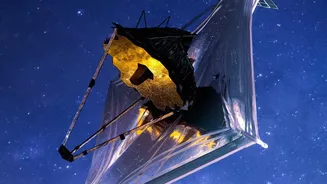
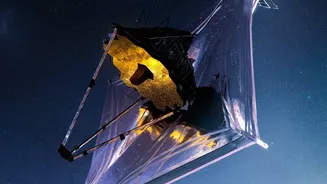
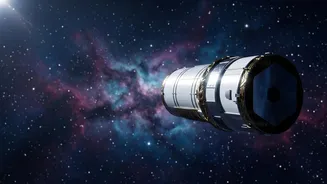
On August 30, 2026, a SpaceX Falcon Heavy rocket carried NASA's next great observatory, the Nancy Grace Roman Space Telescope, into space. Named after NASA's first chief of astronomy, the telescope is now on a million-mile journey to its operational orbit.
Unlike its famous predecessors, Hubble and Webb, which excel at detailed, close-up views of cosmic objects, Roman is designed for something different: speed and scale. It is a survey telescope, built to rapidly scan vast stretches of the heavens and create the largest cosmic maps ever conceived. Its primary mission is to tackle some of the biggest mysteries in astrophysics, including dark energy, dark matter, and the census of planets beyond our solar system.
The Power of a Panoramic View
Roman's transformative potential lies in its incredibly wide field of view. While it has the same size primary mirror as the Hubble Space Telescope, its Wide Field Instrument can capture an area of the sky at least 100 times larger in a single snapshot. Imagine trying to understand a forest by looking through a straw—that’s similar to how Hubble takes its deep, narrow images. Roman, in contrast, can see the entire forest at once, with the same sharpness and detail. This efficiency is staggering; in its five-year primary mission, Roman will survey 50 times more sky than Hubble has in over three decades of operation. This ability to gather massive amounts of data quickly will allow scientists to study cosmic phenomena on a statistical scale never before possible.
Hunting for Dark Energy
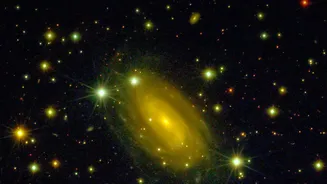
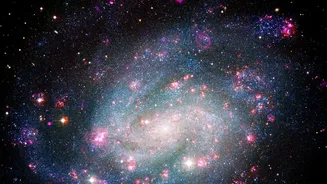
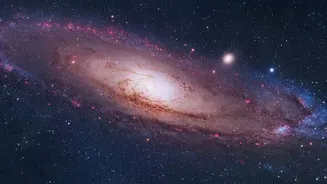
One of Roman’s key goals is to investigate the mysterious force known as dark energy, which is causing the expansion of the universe to accelerate. Scientists still don't know what it is, but by mapping the distribution of over a billion galaxies across cosmic time, Roman will provide crucial new data. Its wide-angle view will allow it to detect the subtle ways that distant galaxies are distorted by the gravity of intervening matter, a phenomenon called weak gravitational lensing. It will also map the clustering of galaxies and measure light from thousands of distant supernovae. By using multiple independent methods to measure the universe's expansion history, Roman aims to settle debates about whether dark energy is constant or changes over time.
A Census of Alien Worlds
Beyond cosmology, Roman is set to revolutionize the search for exoplanets. It will conduct a massive survey of the central bulge of our Milky Way galaxy, monitoring hundreds of millions of stars. This allows it to hunt for planets using a technique called gravitational microlensing. This method is sensitive enough to find planets as small as Mars and even rogue planets that drift through space without a host star. While missions like Kepler found thousands of planets by watching for the dimming of stars, Roman's microlensing survey is expected to discover thousands more, providing a more complete census of planetary systems in our galaxy. Additionally, its powerful Coronagraph Instrument will demonstrate technology to directly image Jupiter-like planets by blocking a star's light.
A Cosmic Discovery Engine
Roman is not a replacement for Hubble or Webb but a powerful complement. While Webb peers deep into the infrared to study the earliest universe and Hubble provides ultra-detailed views in multiple wavelengths, Roman will be the great surveyor. It will act as a discovery engine, identifying countless new targets and phenomena in its vast datasets that other telescopes can then study in greater detail. The sheer volume of data—expected to be around 1.4 terabytes per day—will be made public, creating a resource for astronomers globally for decades to come. This cosmic atlas promises not only to answer known questions but to uncover entirely new ones we haven't yet thought to ask.