




The Post-1983 Hangover and a Near Miss
The triumph in 1983 was monumental, but it also cast a long shadow. As co-hosts of the 1987 World Cup, India were overwhelming favourites. The team, still featuring heroes from the '83 squad, played confidently on home soil. They topped their group and
stormed into the semi-finals, with the entire nation expecting a final showdown against rivals Pakistan. But at Mumbai's Wankhede Stadium, England had other plans. English batsman Graham Gooch famously used the sweep shot to neutralise India's spin attack, scoring a century that powered his team to a formidable total. Chasing 255, India's batting faltered under pressure and they fell short by 35 runs, ending the dream of back-to-back titles in heartbreak. It was the first sign that repeating the magic of 1983 would be far from simple.
A Team in Transition and the Tendulkar Burden
The 1990s was a decade of massive change. The 1992 tournament was a poor campaign, where India failed to advance from the round-robin stage, winning only two of their eight matches. By the 1996 World Cup, co-hosted by India again, a new phenomenon had taken hold: Sachin Tendulkar. The team had become dangerously reliant on the young master. His dismissal often signaled a collapse, and never was this more tragically evident than in the infamous semi-final against Sri Lanka at Eden Gardens. Chasing 252, Tendulkar was batting sublimely, leading India to a comfortable 98 for 1. But his stumping triggered a catastrophic collapse, with India slumping to 120 for 8. The ensuing crowd trouble forced the match to be awarded to Sri Lanka, leaving a lasting image of a tearful Vinod Kambli walking off the field. It underscored a painful truth: one genius player couldn't win the World Cup alone.
So Close, Yet So Far Against the Aussies
Under the bold captaincy of Sourav Ganguly, a new, aggressive Indian team emerged. The 2003 World Cup in South Africa saw a remarkable turnaround after a shaky start. A revitalised squad, blending the experience of Tendulkar, the solidity of Rahul Dravid, and the firepower of new stars, went on an eight-match winning streak to storm into the final. Tendulkar was the tournament's top scorer, and Ganguly himself scored a crucial century in the semi-final against Kenya. But the final hurdle was the invincible Australian team. Led by Ricky Ponting, Australia was in the middle of a dominant era where they won three consecutive World Cups (1999, 2003, 2007) and were unbeaten in the 2003 and 2007 tournaments. In the final, Ponting played a brutal captain's knock, and Australia set a mammoth target of 360. India crumbled under the pressure of the chase, losing by a massive 125 runs. It was a clinical demolition by one of the greatest teams in cricket history.
The 2007 Debacle and the Dhoni Revolution
If 2003 was a heroic failure, 2007 in the West Indies was an unmitigated disaster. Despite a star-studded lineup featuring Dravid, Tendulkar, and Ganguly, India suffered a shock defeat to Bangladesh in their opening match. Another loss to Sri Lanka sealed their fate, leading to a humiliating first-round exit. The failure was considered one of the worst moments in Indian cricket history and led to a massive public outcry. However, this catastrophe became the catalyst for radical change. It marked the end of an era for several senior players in the one-day setup and paved the way for a new generation. A young captain, MS Dhoni, was handed the reins of the T20 side, which he led to a surprise World T20 victory in 2007. This win infused fresh belief and a new, fearless culture into the team.
The Final Piece of the Puzzle
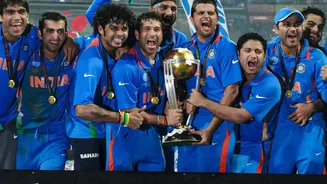
Building on the 2007 T20 success, Dhoni, along with coach Gary Kirsten, meticulously built a balanced, versatile, and mentally tough team. Unlike the teams of the 90s, this unit wasn't dependent on one or two players. It had multiple match-winners like Gautam Gambhir, Yuvraj Singh, Virender Sehwag, and Zaheer Khan. Leading up to the 2011 World Cup, held at home, the team was a perfect blend of seasoned veterans and confident youth. They handled the immense pressure of expectation with a calm assurance that was personified by their captain. The final against Sri Lanka was the ultimate test. After losing Sehwag and Tendulkar early in the chase of 275, Gambhir anchored the innings with a brilliant 97. Then, in a masterstroke, Dhoni promoted himself up the order and played a masterful unbeaten innings of 91, finishing the 28-year wait with an iconic six.