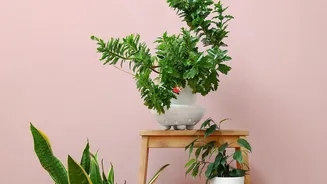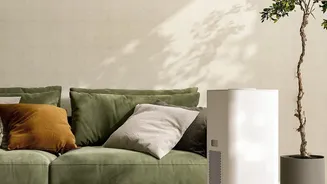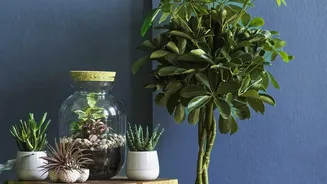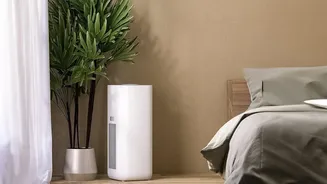






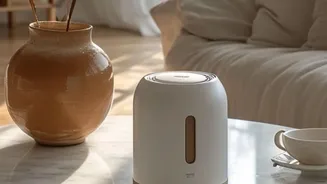
The desire for clean, fresh indoor air has led many to a crossroads: should you trust modern technology or Mother Nature? This brings us to the popular debate between air purifiers and houseplants, two very different tools for the same goal.
The Green Myth: The Truth About Houseplants
The belief
that houseplants are effective air purifiers stems largely from a well-known NASA study from 1989. This study found that, in a small, sealed chamber, certain plants could remove volatile organic compounds (VOCs) like benzene and formaldehyde from the air. For decades, this has been interpreted to mean that a few potted plants can scrub the air in our homes and offices. However, more recent scientific reviews have debunked this as a practical solution. The problem is that our homes are not sealed chambers; they have constant air exchange from windows, doors, and ventilation systems. A 2019 review by researchers at Drexel University concluded that the air exchange in a normal room cleans the air far more quickly than plants can. To match the air-cleaning power of a building’s ventilation or a single air purifier, you would need an impractical number of plants—some studies estimate between 10 and 1,000 plants per square meter. This would turn a typical living room into an impassable jungle. While plants do offer aesthetic and psychological benefits, such as boosting mood and lowering stress, they should not be considered a meaningful tool for air purification in a real-world setting.
The Power of the HEPA Filter
On the other side of the debate is the air purifier, a machine specifically engineered for one job: cleaning the air. The gold standard in this technology is the HEPA filter, which stands for High-Efficiency Particulate Air. To earn the 'True HEPA' label, a filter must be proven to remove at least 99.97% of airborne particles that are 0.3 microns in size—a dimension that is often the most difficult to trap. For perspective, a human hair is about 50-150 microns wide. These filters are incredibly effective at capturing particulate matter. This includes common irritants like dust, pet dander, pollen, mold spores, and even some bacteria and viruses. By physically trapping these tiny particles in a dense mat of fibers, HEPA purifiers can significantly reduce the concentration of allergens and pollutants, which is especially beneficial for people with asthma or allergies. Studies have shown that using a HEPA purifier can reduce indoor fine particulate matter (PM2.5) by over 50%.
What HEPA Filters Can't Do: The Gas Problem
While HEPA filters are masters of capturing solid particles, they have a significant blind spot: gases. Volatile Organic Compounds (VOCs) are gaseous pollutants that are released from common household items like paint, furniture, cleaning products, and carpets. These can include chemicals like formaldehyde and benzene—the very pollutants plants were shown to remove in lab settings. Because VOCs are individual molecules, they are too small to be trapped by a HEPA filter and pass right through it. To address this, many high-quality air purifiers combine a HEPA filter with an activated carbon filter. Activated carbon has a highly porous structure that allows it to adsorb gas molecules, trapping odors and chemicals that HEPA filters miss. So, a purifier with only a HEPA filter will handle dust and pollen, but a model with both HEPA and activated carbon is needed for more comprehensive purification that includes gases and smells.
The Verdict: Right Tool for the Right Job
When you directly compare the two, it's not a fair fight. In terms of sheer air-cleaning power, a single air purifier is thousands of times more effective than a houseplant. The Clean Air Delivery Rate (CADR), a standard metric for purifier effectiveness, for an average machine is over 100 cubic meters per hour, while a plant's is less than one. For significant air purification, there is no contest: an air purifier equipped with a HEPA filter is the only scientifically-backed choice. Houseplants are not useless, but their role is different. They are fantastic for adding life and beauty to a space and have proven psychological benefits. However, relying on them to clean your air is a myth based on a misinterpretation of an old study. The most effective strategy for a healthy home environment isn't choosing one over the other. It's using both for their intended strengths: an air purifier for the heavy-lifting of filtration and plants for aesthetic beauty and mental well being.