



A Mission to a Mysterious Water World
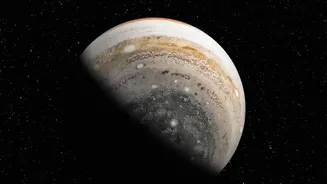
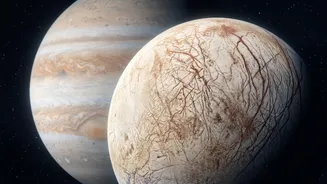
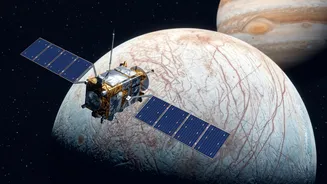
For decades, scientists have been captivated by Europa, one of Jupiter's largest moons. Evidence strongly suggests that a saltwater ocean, potentially twice the volume of all of Earth's oceans combined, churns beneath its icy shell. This makes it one of the most
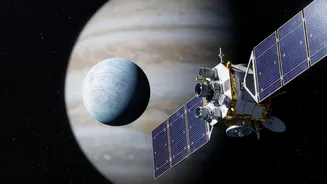
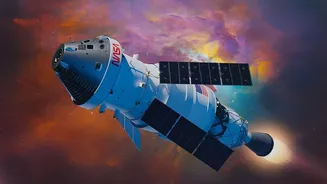
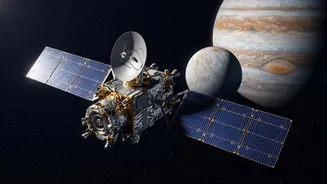
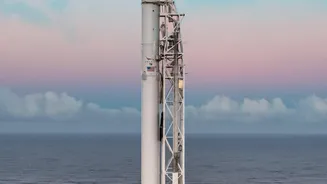
compelling places in our solar system to search for life beyond our planet. To explore this potential, NASA designed the Europa Clipper, the largest interplanetary spacecraft the agency has ever built. Launched in October 2024, its primary goal is not to land, but to conduct dozens of close flybys of the moon. By swooping as low as 25 kilometers above the surface, its suite of powerful instruments will analyze the moon in unprecedented detail, seeking to understand its ocean, ice shell, and composition. The mission's trajectory is a long and complex one, involving gravity assists from Mars in 2025 and a final one from Earth in late 2026 to slingshot it toward Jupiter, where it's scheduled to arrive in 2030.
The Tools for an Alien Investigation
To peek beneath the ice and sniff the faint atmosphere, Europa Clipper is equipped with a sophisticated array of nine science instruments. Two of the most critical are the MAss Spectrometer for Planetary EXploration (MASPEX) and the SUrface Dust Analyzer (SUDA). Think of them as the spacecraft's sense of smell and taste. MASPEX will analyze gases in Europa’s extremely thin atmosphere. If there are plumes of water vapor venting into space from the ocean below, MASPEX is designed to determine their chemical makeup, sniffing for organic molecules that could be signs of biological processes. Meanwhile, SUDA will scoop up and analyze tiny ice and dust particles ejected from Europa's surface by micrometeorite impacts. By studying these grains, scientists hope to find salts and organic compounds that could reveal the chemistry of the subsurface ocean without ever needing to drill through the ice.
A Deep-Space Dress Rehearsal
Before sending these delicate instruments on a 1.8-billion-mile journey, they must be proven to work flawlessly. Testing on Earth can only go so far. A key test for the spacecraft's ice-penetrating radar, known as REASON (Radar for Europa Assessment and Sounding: Ocean to Near-surface), was conducted during a flyby of Mars in early 2025. The instrument, which will be used to measure the thickness of Europa’s ice shell and search for pockets of water, successfully bounced radar signals off Mars and collected a trove of data, confirming it was working perfectly. Other instruments, like MASPEX and SUDA, underwent extensive ground-based testing and calibration in specialized vacuum chambers and clean rooms to ensure they could withstand Jupiter's harsh radiation environment and deliver precise results. These tests simulate the vacuum of space and the extreme conditions the spacecraft will face, ensuring the data sent back is pure and uncontaminated by Earthly materials.
From the Lab to the Jovian System
With the launch successful and its instruments passing crucial in-flight and ground tests, the Europa Clipper mission is on track for its long journey. After its final gravity assist from Earth in December 2026, the spacecraft will coast for several years until it finally enters orbit around Jupiter in April 2030. From there, it will begin its four-year science phase, performing nearly 50 flybys of Europa. Each pass will allow the instruments to gather more data, layering observations to build a comprehensive picture of the moon. The information gathered by the Clipper's sensors will not only characterize Europa's potential for life but will also help scout locations for a potential future lander mission. The success of these early tests is a vital step, giving scientists confidence that when the spacecraft finally reaches its destination, it will be ready to unlock the secrets of this mysterious ocean world.