



The Tyranny of the Rocket Equation
In spaceflight, mass is the ultimate enemy. Every gram launched into the sky requires a massive amount of propellant to overcome Earth's gravity. This is why rocket engineers are obsessed with shedding weight. For decades, the solution for reusable rockets,
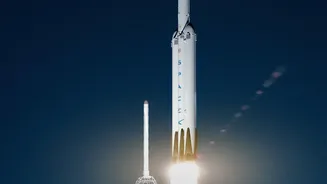
like SpaceX's own Falcon 9, has been deployable landing legs. While revolutionary, these legs come with a significant penalty: they are 'dead weight'. They are heavy structures that are used for only the last few moments of the flight but must be carried all the way up and back down, which reduces the amount of useful payload—like satellites or cargo—the rocket can carry.
Enter 'Mechazilla': The Ground Is the Landing Gear
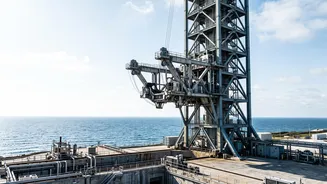
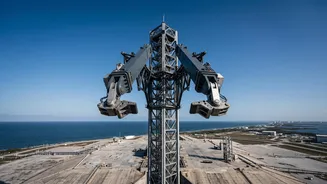
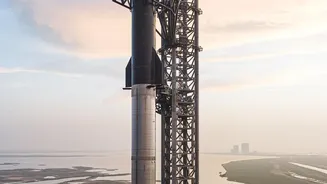
SpaceX's solution for Starship is to move the landing hardware off the rocket entirely and put it on the ground. The launch tower, nicknamed 'Mechazilla,' is equipped with two large, robotic arms often called 'chopsticks'. The strategy is for the returning Super Heavy booster to use its engines to slow down and position itself precisely next to the tower. The chopsticks then close around reinforced points on the booster, securing it before its engines shut down and lowering it back onto the launch mount. In essence, SpaceX is turning the launch tower into a combination launch pad and recovery system, replacing an onboard system with a ground-based one.
The Payoff: Rapid, Airline-Style Reusability
The primary benefit of this approach is a dramatic increase in payload capacity by eliminating the mass of the legs. For a rocket designed to carry over 100 tons, this is a significant advantage. But the bigger prize is rapid reusability. A booster caught by the tower is already at the launch site, ready for inspection and integration for its next flight. This could slash the turnaround time from weeks, as with the Falcon 9 which must be transported back to the pad, to potentially just hours. This high launch cadence is critical for SpaceX's long-term ambitions, such as launching fleets of Starlink satellites and establishing a city on Mars, which requires numerous tanker flights to refuel a Mars-bound craft in orbit.
An Audacious and Risky Gamble
While the benefits are immense, so are the risks. The tower-catch maneuver requires almost unimaginable precision. The massive booster must fly itself into a very narrow target window, controlling its position and velocity with pinpoint accuracy. A failure could be catastrophic, potentially destroying not just the multi-million dollar booster but also the entire launch tower, crippling operations for months. Early tests have shown how narrow the margins for success are, with automated safety checks aborting catch attempts if conditions are not perfect, defaulting to a safer splashdown in the ocean instead. The entire system—from the booster's grid fins and engines to the tower's hydraulic arms—must work in perfect concert.