







Meet the 'Warm Neptunes'
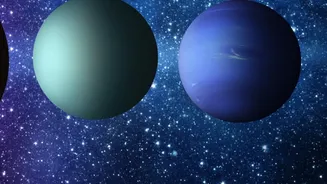
Imagine a planet larger than Earth but smaller than Neptune, orbiting its star so closely that its atmosphere is searing hot. This is a 'warm Neptune' or 'sub-Neptune'. These worlds are not candidates for life themselves; they are gas-rich planets often
with thick hydrogen and helium atmospheres, existing in a temperature range far too extreme for liquid water. Interestingly, these types of planets are among the most common found in our galaxy, yet nothing like them exists in our own solar system, making them a fascinating puzzle for planetary scientists. Their proximity to their stars means they are often tidally locked, with one side in perpetual daylight and the other in permanent night.
The Cosmic Clue in Methane
Methane is a simple molecule, but in the context of an exoplanet's atmosphere, it's incredibly significant. On Earth, the vast majority of methane is produced by living organisms, from microbes in wetlands to cows. Because of this strong link to biology, it has long been considered a key 'biosignature'—a potential sign of life. However, methane can also be produced by non-biological processes, like volcanic activity or reactions in a planet's interior. The challenge for astronomers using powerful tools like the James Webb Space Telescope (JWST) is to tell the difference. Methane is unstable in an atmosphere and gets broken down by starlight, so to be detectable, it must be constantly replenished from a large source. The question is: is that source biological or geological?
Studying the Uninhabitable to Find the Habitable
This is where the warm Neptunes come in. Since these planets are almost certainly lifeless due to their extreme conditions, any methane detected in their atmospheres must have a non-biological origin. By studying the atmospheric chemistry of these worlds, scientists can build a library of 'false positives'. They can see exactly what a planet's atmosphere looks like when methane is produced by geology, chemistry, and high temperatures alone. Recent JWST observations of warm Neptunes like WASP-107b have detected methane, but in amounts far lower than chemical models would predict for such a world, pointing to complex mixing processes deep within the planet's hot interior. These findings provide a crucial baseline, helping scientists understand the full range of planetary processes that can create a methane signal without any involvement from life.
Beyond the 'Goldilocks Zone'
The traditional search for life has focused on the 'habitable zone,' often called the 'Goldilocks zone,' where a planet is at the right distance from its star for liquid water to exist on its surface. But this new research shows that habitability is about more than just temperature and water. It's about chemistry. The context of other molecules matters immensely. For instance, researchers have proposed that on a rocky, Earth-like planet, an atmosphere rich in both methane and carbon dioxide, but with very little carbon monoxide, would be a strong indicator of life, as non-biological processes struggle to create that specific chemical imbalance. By understanding the chemical signatures on lifeless warm Neptunes, we can be much more confident when we find a signature on a temperate, rocky world that doesn't fit the non-biological pattern.