






The Brain's Gatekeepers Revealed
Our ability to learn and remember relies on a complex process inside our brain cells, or neurons, called endocytosis. This is how neurons absorb essential materials like nutrients and signaling molecules from their surroundings. For a long time, the exact
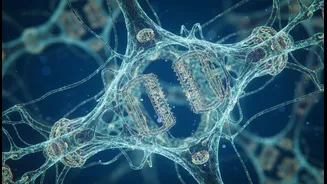
mechanics controlling this vital intake process were a mystery. New research from scientists at Penn State, however, has identified a crucial player: a microscopic, lattice-like structure just beneath the neuron's surface. Known as the membrane-associated periodic skeleton (MPS), this structure was previously thought to just provide shape to the cell. But as the new study reveals, its role is far more active and important. It acts as a physical gatekeeper, deciding what gets into the cell and when.
A Tightly Regulated System
Think of the MPS as a disciplined bouncer for the brain cell. Using advanced super-resolution microscopy, which can see things 10,000 times smaller than a human hair, researchers observed that the MPS actively regulates almost all major forms of endocytosis. According to Ruobo Zhou, an assistant professor at Penn State who co-led the study, the MPS acts as a physical barrier. When a neuron needs to take in a specific molecule, this gatekeeper structure opens to allow it in, and then closes again. This tight regulation is essential for the routine maintenance of neurons and the complex processes that underpin learning and memory.
When the Gates Weaken
This gatekeeping system is dynamic, which allows neurons to ramp up activity when they need to respond quickly. However, this flexibility has a downside. The research suggests that if the MPS structure weakens or degrades, it can no longer properly control what enters the cell. This problem is particularly relevant to aging and neurodegenerative diseases. As we age, these critical gatekeeper proteins can accumulate damage, leading to a loss of the pore's integrity and making the barrier leaky. This deterioration means the cell can begin to absorb things too rapidly and without proper control, a scenario that has significant consequences for brain health.
A Link to Alzheimer's Disease
The most compelling part of the new research involves its connection to Alzheimer's disease. To investigate the link, the scientists created cellular experiments that mimicked the early stages of the disease. They prompted neurons to produce extra amyloid precursor protein (APP), a key protein associated with Alzheimer's. They discovered that when they weakened the MPS, the neurons absorbed APP much more rapidly. Once inside, this protein is cut into a toxic fragment strongly linked to the progression of Alzheimer's. With a faulty gatekeeper, neurons accumulated more of this harmful molecule and showed increased signs of cell death. This finding suggests that a breakdown in this microscopic skeleton could be an early event in the disease's development.
Reinforcing the Brain's Defenses
The discovery that a weakened MPS accelerates the intake of harmful proteins opens up a groundbreaking new idea for treatment. Instead of just trying to clear out toxic proteins after they've already accumulated, what if we could reinforce the gatekeepers to prevent them from getting in so easily in the first place? The research suggests that finding ways to stabilize and protect the MPS could become a powerful new strategy for preventing brain cell damage. By keeping these gatekeepers strong, it might be possible to slow the devastating chain reaction that leads to conditions like Alzheimer's. This shifts the focus from cleanup to prevention at a fundamental, cellular level.