






Hours hunched over a laptop can lead to the dreaded 'tech neck', causing stiffness and aches in your neck, shoulders, and back. Reclaim your comfort with a few simple movements you can do right at your desk to counteract the strain.
1. The Chin Tuck
This subtle but powerful
move helps correct forward head posture and relieves strain on the back of your neck. While sitting or standing straight, gently glide your chin and head straight back, as if you are making a double chin. Be careful not to tilt your head up or down; the movement should be parallel to the floor. You should feel a gentle stretch at the base of your skull and an activation of the muscles in the front of your neck. Hold this position for 3-5 seconds, then relax. Repeat this 10 to 15 times to help realign your posture and ease chronic tension.
2. Upper Trapezius Stretch
The upper trapezius muscles run from your neck down to your shoulders and often become tight and sore from holding your head in one position. To stretch them, sit tall in your chair and gently drop your right ear toward your right shoulder. You can increase the stretch by placing your right hand on the left side of your head and applying very light pressure. Avoid pulling forcefully. To deepen the stretch further, you can hold onto the side of your chair with your left hand. Hold for 20-30 seconds, breathing deeply, and then slowly return to the center and repeat on the other side. This provides targeted relief for that common 'knot' feeling in your shoulders.
3. Scapular Squeeze
This exercise strengthens the muscles between your shoulder blades (the rhomboids), which helps to pull your shoulders back and counteract a slouched posture. While sitting or standing with your arms relaxed at your sides, gently squeeze your shoulder blades together. Imagine you are trying to hold a pencil between them. Be sure to keep your shoulders down and away from your ears; avoid shrugging. Hold the squeeze for 3-5 seconds, then relax. Performing 10-15 repetitions of this movement helps to activate and awaken these often underused postural muscles, providing lasting relief from upper back aches.
4. Thoracic Spine Extension
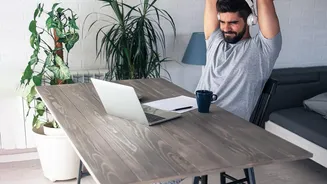
Hunching forward all day leads to a stiff upper and mid-back (thoracic spine). This stretch helps to reverse that curve. Sit toward the front of your chair with your feet flat on the floor. You can either place your hands behind your head with fingers interlaced or reach back and grip the top of your chair's backrest. Gently arch your upper back, looking up towards the ceiling and allowing your chest to open up. Breathe into the stretch, feeling your upper back extend. Hold for 15-30 seconds and then slowly return to a neutral position. Repeat this several times throughout the day to improve mobility in your spine.
5. Doorway Chest Stretch
Constant typing and mousing can cause the muscles in your chest (pectorals) to become tight, pulling your shoulders forward. A doorway stretch is an excellent way to open them up. Stand in an open doorway and place your forearms on the frame, with your elbows bent at a 90ndegree angle. Step forward with one foot until you feel a gentle stretch across your chest and the front of your shoulders. Hold this position for $20$-$30$ seconds, ensuring you don't push to the point of pain. This stretch provides a much needed counterbalance to the 'computer hunch' and promotes better overall posture.