


What Exactly Is a Solar Storm?
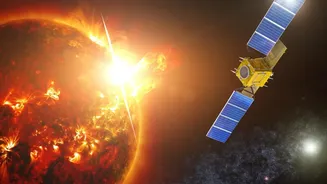
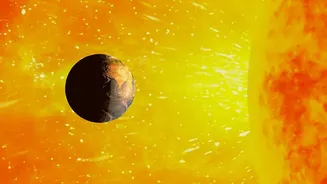
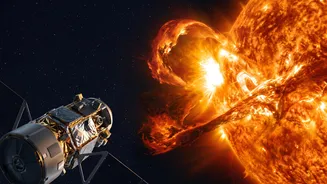
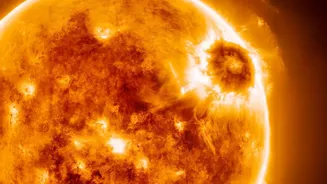
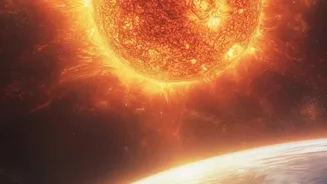
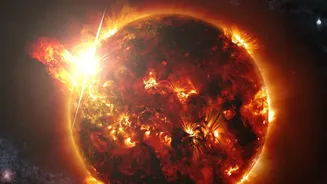
A solar storm is a major disturbance on the Sun, often involving a solar flare—an intense burst of radiation—or a Coronal Mass Ejection (CME), which is a massive cloud of magnetised plasma and particles hurled into space. While flares travel at the speed
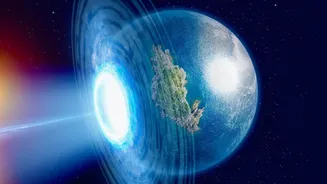
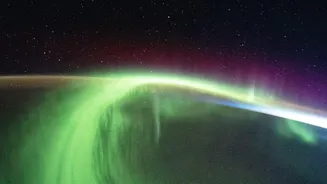
of light and reach Earth in about eight minutes, CMEs are slower, taking one to three days to arrive. When a CME slams into Earth's magnetic field, it can trigger a geomagnetic storm. This is the primary phenomenon that threatens our modern infrastructure, creating beautiful auroras but also posing a significant risk.
The Power Grid: A Primary Target
The most significant threat from a severe solar storm is to our electrical grids. Geomagnetic storms can create powerful, low-frequency currents in the ground, known as geomagnetically induced currents (GICs). These currents can flow into long conductors like high-voltage transmission lines, overloading the system. The primary risk is to the large transformers that are the backbone of the grid. GICs can cause them to overheat and, in a worst-case scenario, melt or be permanently damaged. Replacing these massive, custom-built transformers could take months or even years, leading to prolonged, widespread blackouts as seen on a smaller scale during the 1989 Quebec event.
Satellites and GPS: Our Vulnerable Eyes in the Sky
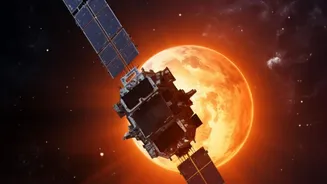
Satellites operate outside the full protection of Earth's atmosphere, making them highly susceptible to space weather. Energetic particles from a solar storm can damage sensitive electronics, degrade solar panels, and cause 'phantom commands' that disrupt operations. A strong storm can also heat and expand Earth's upper atmosphere, increasing drag on satellites in low-Earth orbit. This can cause them to lose altitude and even fall out of orbit, as happened to dozens of Starlink satellites in 2022. The consequences would ripple through society, as we rely on satellites for GPS navigation, weather forecasting, financial transactions, and global communications. Even minor GPS inaccuracies of a few metres can disrupt aviation, shipping, and precision agriculture.
The Internet: An Undersea Apocalypse?
While your personal smartphone or laptop is generally too small to be directly affected by induced currents, the global internet is a different story. The internet's backbone is a vast network of undersea fiber-optic cables. The glass fibers themselves are immune to solar storms, but the signal repeaters—electronic devices placed every 50 to 150 kilometers to boost the signal—are vulnerable. These repeaters are powered by long copper conductors that run alongside the fiber, making them a perfect target for geomagnetically induced currents. A 2021 study warned that a severe storm could fry these repeaters, potentially taking down long-haul international internet links for weeks or months while specialized ships make repairs. This could fragment the internet, leaving continents isolated.
Radio Communications and Air Travel
Solar flares and the resulting geomagnetic storms can wreak havoc on the ionosphere, the layer of the atmosphere that high-frequency (HF) radio waves bounce off of for long-distance communication. This can cause radio blackouts, cutting off communication for aircraft on polar routes, emergency services, and maritime shipping. For safety, airlines may have to reroute flights away from polar regions where the effects are strongest, leading to longer travel times and increased fuel consumption. The combination of communication blackouts and potential GPS inaccuracies makes air travel particularly sensitive to space weather events.