



The New Brains in Orbit
Artificial Intelligence is no longer just a theoretical concept for space missions; it's a proven asset. For the Indian Space Research Organisation (ISRO), AI has become essential for everything from mission planning to autonomous navigation. Think of
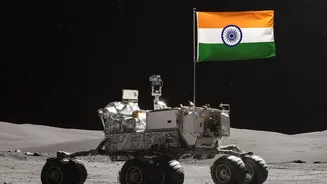
it as giving our spacecraft the ability to think for themselves. This was demonstrated powerfully during the Chandrayaan-3 mission, where AI algorithms played a crucial role in guiding the Pragyan rover. The AI helped the rover navigate the lunar surface, steering it clear of obstacles and identifying safe paths, all while a special camera used AI to analyse the landing zone for potential hazards. This level of autonomy is critical as missions venture further into deep space, where communication delays can make real-time human control impossible.
Smarter Satellites, Safer Earth
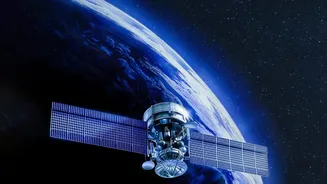
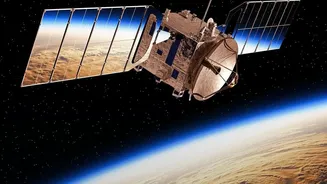
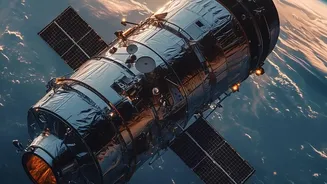
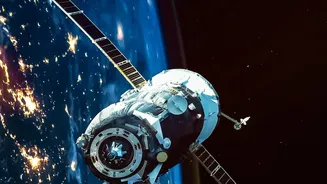
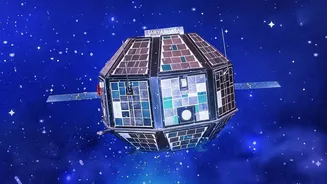
The application of AI extends far beyond navigating rovers on the Moon. ISRO is leveraging AI and machine learning to make its vast network of satellites more efficient and powerful. Experts at the recent National Space Technology Conclave 2026 highlighted that on-board AI processing will enable satellites to analyse data in space itself. This 'edge computing' allows for real-time decision-making, which is revolutionary for disaster management, urban planning, and national security surveillance. For instance, AI algorithms can sift through massive volumes of satellite imagery to detect deforestation, monitor crop health, or identify changes in water bodies much faster than human analysts ever could. By automating data analysis and filtering out irrelevant information, such as clouded images, AI ensures that we get higher quality, more actionable intelligence from our assets in the sky.
The Quantum Leap for Space Security
While AI offers intelligence, quantum technology promises security. The Government of India has committed over ₹6,000 crore to the National Quantum Mission (NQM), a strategic initiative running from 2023 to 2031 to make India a leader in this futuristic field. A key goal of the NQM is to develop satellite-based secure quantum communications. Traditional encryption methods are vulnerable to being broken by powerful quantum computers, a threat that nations are taking seriously. Quantum Key Distribution (QKD) offers a solution by using the principles of quantum mechanics to create hack-proof communication channels. Any attempt to intercept a QKD-protected message would instantly be detected. ISRO is actively working with the NQM to develop this technology for its satellites, aiming to secure everything from military communications to civilian banking transactions.
Beyond Communication: Quantum's Other Powers
The potential of quantum research in space is not limited to secure communications. The NQM also aims to develop ultra-precise atomic clocks and quantum sensors. These technologies are vital for navigation, offering accuracy far beyond current GPS capabilities. Enhanced atomic clocks would improve the precision of India's own navigation system, NavIC, making it more robust and secure. Furthermore, quantum sensors could lead to next-generation instruments for Earth observation, capable of measuring gravitational fields with unprecedented accuracy. This would revolutionize our understanding of climate change, groundwater levels, and geological shifts. By developing these advanced capabilities, India is not just protecting its assets but is also creating new tools for scientific discovery.
Building the Ecosystem for a New Era
Realising this ambitious roadmap requires more than just government research. The Indian Space Policy 2023 and the establishment of IN-SPACe (Indian National Space Promotion and Authorisation Center) are designed to create a thriving ecosystem that includes private companies and startups. The goal is to grow India's share of the global space economy from 2% to 8% by 2033. The government has also launched the IndiaAI mission with an outlay of over ₹10,000 crore to develop the broader AI ecosystem in the country. By fostering public-private partnerships and encouraging investment, India is building the necessary infrastructure and talent pool to translate its AI and quantum research into tangible technological and economic advantages, securing its future as a dominant space power.