



The Standard Cosmic Blueprint
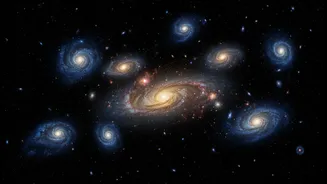
For decades, the story of how galaxies formed seemed relatively straightforward. The prevailing theory, known as the hierarchical model of galaxy formation, suggested a bottom-up approach. In the cosmic dark ages after the Big Bang, small clumps of matter
and gas slowly came together under the influence of gravity. These small proto-galaxies would then merge over billions of years, gradually building the large, structured and orderly spiral and elliptical galaxies, like our own Milky Way, that we see in the universe today. According to this model, the earliest galaxies should have been small, chaotic, and structurally simple. They were expected to be messy, turbulent systems, still in the throes of their initial assembly, not the settled, mature structures common in the modern cosmos. This was the benchmark against which all new discoveries were to be measured.
A New Cosmic Surprise
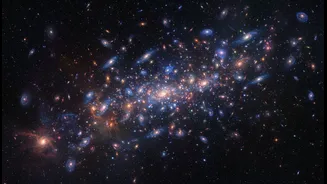
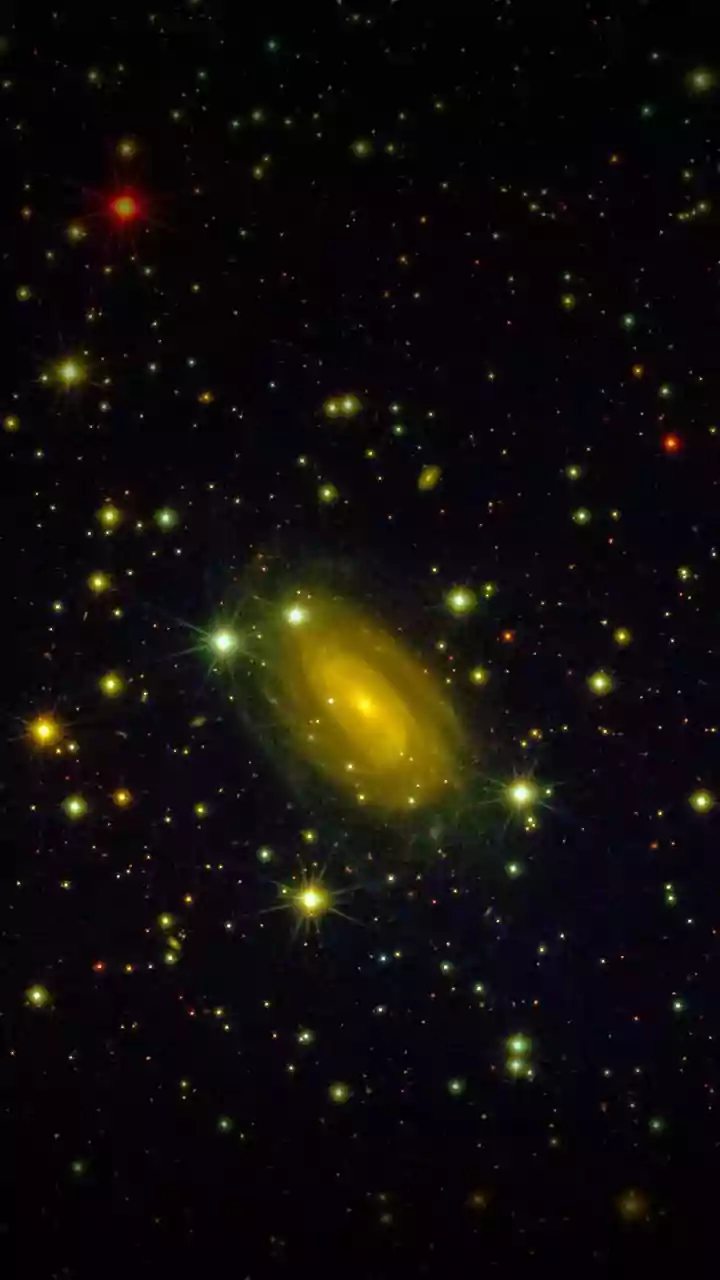
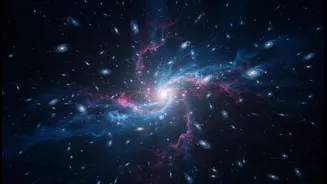
Recent studies, primarily using the unparalleled power of the James Webb Space Telescope (JWST), are painting a very different picture. Astronomers are finding galaxies in the early universe, seen as they were when the cosmos was just a fraction of its current age, that are far more developed than models predicted. One recent study discovered a galaxy with a dense, rotating structure of stars at its core, known as a nuclear disc, seen as it was over nine billion years ago. Such features were thought to take billions of years to develop, yet here one was, already in place when the universe was still young. Another observation found a massive galaxy, existing less than two billion years after the Big Bang, that showed no evidence of rotation at all. This is a trait normally seen in much older, more evolved galaxies that have undergone numerous mergers, a process thought to require an enormous amount of time. These findings suggest that the path to galactic maturity might be much faster than previously assumed.
Rewriting the Rules of Galaxy Growth
This “hidden complexity” is forcing a major rethink of galaxy evolution. The presence of organized structures like nuclear discs and stellar bars so early in cosmic history suggests that galaxies could build themselves from the inside out much more quickly and efficiently than thought. Rather than just being chaotic messes of gas, some early galaxies were already organized systems, capable of channeling gas and stars towards their centres to build complex features. These early bloomers challenge the standard timeline. The discovery of massive, non-rotating galaxies so soon after the Big Bang also poses a puzzle. The most likely explanation is a merger of two galaxies spinning in opposite directions, a dramatic event that would cancel out their rotation—but finding such a mature system so early is still a surprise. These observations don't necessarily throw out the old models entirely, but they show that key processes were happening far sooner and faster than we believed, hinting at a missing piece in our understanding of the universe's formative years.
The Instruments Peering into the Past
The key to these groundbreaking discoveries is the James Webb Space Telescope. Launched in late 2021, its massive mirror and sensitivity to infrared light allow it to capture light from the most distant objects in the universe. Because light takes time to travel across cosmic distances, seeing a galaxy billions of light-years away means we are seeing it as it was billions of years ago. JWST can peer back to a time when the universe was only a few hundred million years old, an era previously inaccessible to us. This allows astronomers to move beyond theoretical models and directly observe the universe's infancy. By combining JWST's data with other powerful instruments, like the W.M. Keck Observatory in Hawai'i, researchers can get a more complete picture, analysing a galaxy's structure, its rate of star formation, and its chemical composition, providing a detailed look into these ancient cosmic structures.