






A New Kind of Explorer
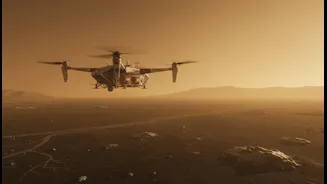
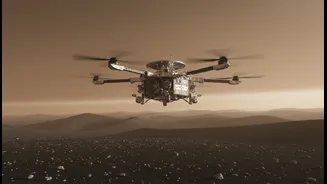
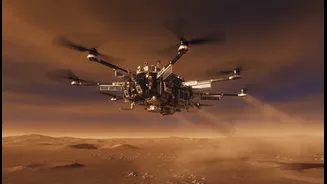
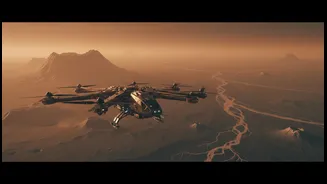
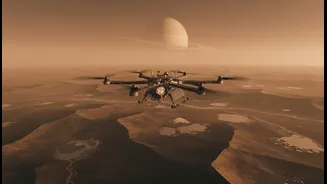
Scheduled to launch in July 2028 and arrive at Titan in 2034, Dragonfly is unlike any planetary probe before it. It’s an octocopter—a drone with eight rotors—designed to be a relocatable lander. Instead of being confined to one landing spot like a traditional
lander, or slowly crawling across the surface like a rover, Dragonfly will fly. This mobility will allow it to travel dozens of kilometers in a single flight, hopping between scientifically interesting locations spread across hundreds of kilometers during its multi-year mission. It's a fundamental shift, moving planetary exploration from a slow-motion crawl to a series of targeted leaps across a new world.
Titan: A Perfect Place to Fly
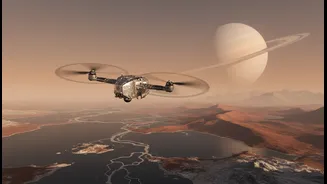
So, why send a drone to Titan? The answer lies in the moon's unique environment, which makes it arguably the easiest place to fly in the entire solar system. Titan's atmosphere is about 50% thicker at the surface than Earth's and its gravity is only about one-seventh as strong. This combination of a dense atmosphere and low gravity is a dream for aviation. It means that a craft needs significantly less power to generate lift compared to Earth, and vastly less than what would be needed on Mars, with its incredibly thin atmosphere. While NASA's Ingenuity helicopter proved flight was possible on Mars, Dragonfly will be a much larger and more capable vehicle, enabled entirely by Titan's friendly skies.
From Crawling to World-Hopping
The change Dragonfly represents cannot be overstated. Mars rovers like Curiosity and Perseverance have been monumental successes, but their movement is painstaking. They travel a few hundred meters per day, carefully navigating treacherous terrain. Dragonfly, by contrast, can fly several kilometers in just tens of minutes. This allows it to bypass obstacles and access a wide variety of geologic settings—from organic sand dunes to the floor of an impact crater—that would be unreachable for a ground-based vehicle. Most of its time will be spent on the ground, using its nuclear power source to recharge batteries and conduct scientific analysis, before taking to the sky again roughly every 16 Earth days.
The Search for Life's Building Blocks
Dragonfly's ultimate goal is to investigate the chemistry of a world that may resemble the early Earth. Titan is rich in complex organic molecules, which are the building blocks of life as we know it. Its surface features rivers, lakes, and seas of liquid methane and ethane, and it's believed to have a subsurface ocean of liquid water. By collecting and analyzing samples from different locations, Dragonfly will search for chemical biosignatures and investigate how far prebiotic chemistry—the steps leading from complex chemistry to biology—has progressed. Scientists are eager to learn if Titan could be habitable, either for water-based life or some other exotic form.
A Blueprint for Future Exploration
The Dragonfly mission is more than just a single trip to an intriguing moon; it's a paradigm shift for how we explore the solar system. The ability to fly on another world opens up countless possibilities. Future missions could use similar rotorcraft to explore the deep canyons of Mars, the volcanic plumes of Jupiter's moon Io, or the hidden terrain beneath the thick clouds of Venus. Dragonfly is the pioneer, demonstrating a new mode of exploration that prioritizes mobility and range. It will transform our ability to survey entire worlds, not just the small patch of ground around a landing site. This flying laboratory will effectively turn a single mission into dozens of them, changing our approach to planetary science forever.