






The Classroom Without Walls
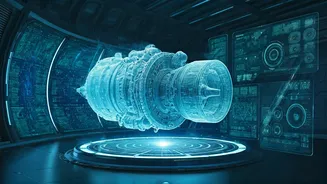
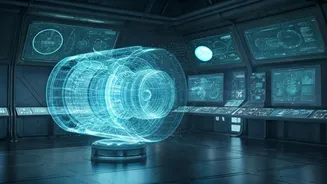
For generations, aerospace engineering education has relied on a combination of dense theory and limited access to physical equipment. Students might spend years studying diagrams of a turbofan engine before ever seeing one up close. The cost and complexity
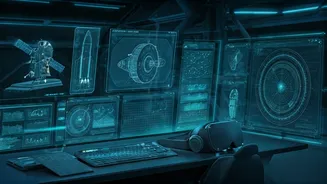
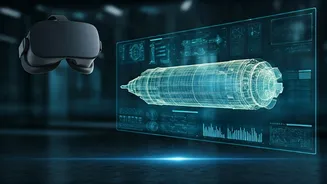
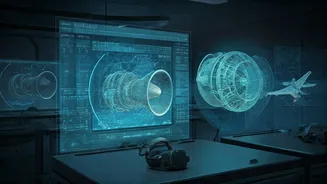
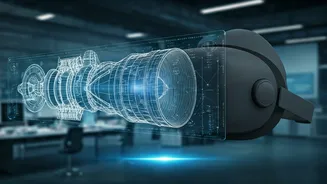
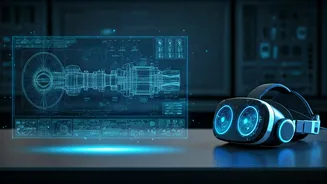
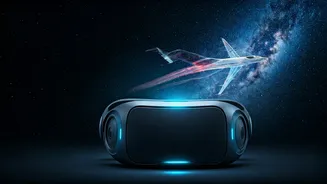
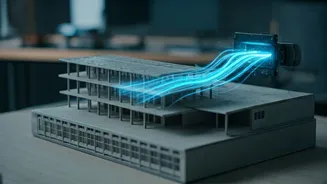
of real-world aerospace hardware—from wind tunnels to rocket propulsion systems—mean that hands-on experience is often a luxury. This is where the virtual revolution begins. An AI-powered VR classroom is a digital twin of a state-of-the-art laboratory. By putting on a VR headset, a student is no longer in a lecture hall in Bengaluru or Pune; they are standing on a virtual hangar floor, inside a mission control room, or floating next to a satellite in orbit. They can walk around, interact with, and even break down complex machinery into its constituent parts, all in a photorealistic, 1:1 scale simulation.
Where AI Becomes the Teacher
The 'VR' part provides the immersion, but the 'AI' provides the intelligence. This is what separates these advanced labs from simple video games or passive 3D models. The Artificial Intelligence layer acts as a dynamic, personalised tutor for every student. Imagine a scenario: a student is tasked with diagnosing a fault in a virtual aircraft’s hydraulic system. As they work, the AI monitors their every move. If they miss a crucial step, the AI can provide a subtle hint or highlight the relevant component. If they make a dangerous mistake—something that would be catastrophic in the real world—the simulation can show them the consequences safely and then guide them through the correct procedure. The AI can also adapt the difficulty, introducing new and more complex problems as the student’s skills grow, ensuring they are always challenged but never overwhelmed. This is personalised learning at a scale that was previously impossible.
Beyond the 'Wow' Factor
While the experience is undeniably futuristic, the practical benefits are what make this technology a game-changer for education. Firstly, there’s safety. Students can experiment with high-pressure systems, volatile chemicals, and complex electronics with zero physical risk. Secondly, there’s cost. A single piece of advanced aerospace testing equipment can cost crores. A VR lab can simulate dozens of such machines for a fraction of the price, democratising access to top-tier training. Thirdly, there is scale and accessibility. An engineering college in a remote part of the country can offer its students the exact same training environment as a top-tier IIT, levelling the playing field. This technology also allows for unprecedented collaboration, where students from different locations can meet in the same virtual space to work on a project together, mirroring the global nature of modern engineering.
Fuelling India's Aerospace Dream
This technological shift couldn't come at a more crucial time for India. With ISRO consistently pushing the boundaries of space exploration and a burgeoning private aerospace and defence sector, the demand for highly skilled, job-ready engineers is skyrocketing. These virtual labs are the perfect training ground to build that workforce. They bridge the critical gap between theory and practice, giving students the confidence and competence that previously only came from years of on-the-job experience. By training on virtual replicas of the very systems they will encounter in their careers—whether at HAL, DRDO, or a new-age space-tech startup—graduates will be able to contribute from day one. This isn't just about better education; it's about building the human capital required to power India's ambition to become a global aerospace leader.