








More Than Just a Match
To understand the gravity of March 1, 2003, you must first understand the context. India and Pakistan had not played a bilateral series for years due to political tensions. Their meetings were restricted to multinational tournaments, making each encounter
a rare, high-stakes spectacle. This was the World Cup, the biggest stage of all. Pakistan had set a challenging target of 274, powered by a magnificent century from Saeed Anwar. The pressure on the Indian dressing room was immense, felt across a billion homes back in India. This wasn't just a game; for millions, it was a matter of national pride, a contest that stopped the nation.
The Assault on Rawalpindi Express
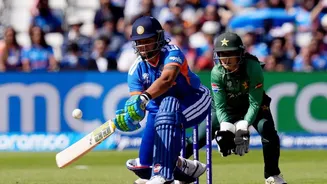
Pakistan's bowling attack was the stuff of legend: Wasim Akram, Waqar Younis, and the fastest bowler in the world, Shoaib Akhtar. The plan was simple: unleash hell. What happened next is etched into cricketing folklore. In Akhtar’s very first over, the second of the innings, Tendulkar didn't just survive; he dominated. The sequence was breathtaking. A scorching cut for four. Then, the shot seen around the world: a ferocious upper-cut that sent the ball sailing over the third-man boundary for six. It was audacious, almost arrogant. He followed it with a sublime flick off his pads for another four. In one over, Tendulkar had seized the momentum, neutralised the fear factor of Akhtar's pace, and sent a clear message: India was there to attack, not just to chase.
Dismantling a Legendary Trio
While the six off Akhtar is the most replayed moment, the genius of the innings lay in how Tendulkar systematically dismantled all three prongs of Pakistan's pace attack. He treated Waqar Younis, the king of reverse swing, with calculated disdain, hitting him for boundaries that disrupted his length. Against the legendary Wasim Akram, he showed respect but never deference, finding gaps with surgical precision. It was a masterclass in playing pace. He wasn't just hitting boundaries; he was controlling the narrative of the chase. He and Virender Sehwag put on 53 runs in just 5.4 overs, effectively breaking the back of the chase before the first powerplay was even over. The world's most feared bowling attack was made to look ordinary.
A Battle Against Pain
As the innings progressed, Tendulkar began to suffer from severe cramps. The physical toll of his high-intensity shot-making under the South African sun was becoming apparent. He could barely run between the wickets, often hobbling for singles. A runner was called for, but the fluency was gone. Despite the excruciating pain, he fought on, determined to see India through. Every run became a testament to his mental fortitude. When he finally fell for 98, miscuing a short ball from Akhtar, the Centurion crowd gave him a standing ovation. He had scored 98 off just 75 balls. He hadn't reached his hundred, but he had done the job. He had taken India to 177/4, within sight of a famous victory.
The Enduring Legacy
Why is an innings of 98 remembered more vividly than many of his 100 international centuries? Because it was the perfect storm of context, quality, and consequence. It came against India’s greatest rival, on the World Cup stage, against a mythical bowling lineup, in a high-pressure chase. Tendulkar later called it the biggest match of his career, even more so than the 2011 final. The innings wasn't just about winning a match; it was about conquering fear and asserting dominance. For an entire generation of Indian cricket fans, that upper-cut six remains a core memory, a symbol of a new, fearless India. Rahul Dravid and Yuvraj Singh calmly guided India home, but the victory was architected by one man's transcendent genius.