



A Long Journey to an Ocean World
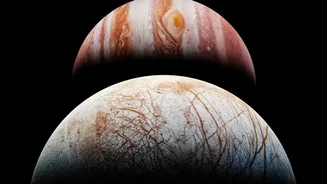
Launched in October 2024, the Europa Clipper spacecraft is currently on a multi-year, 1.8-billion-mile voyage to the Jupiter system. As of September 2026, it is coasting through space, preparing for a gravity-assist flyby of Earth in December 2026. This
maneuver will slingshot the probe toward its final destination, with a scheduled arrival at Jupiter in April 2030. The mission's goal is not to land, but to conduct a series of nearly 50 close flybys of Europa, using a powerful suite of instruments to peer beneath the ice and assess the moon's potential for hosting life. This long, looping path is a clever solution to a major problem: Jupiter’s intense radiation, which could fry a spacecraft’s electronics if it lingered too long.
Peering Beneath the Ice with Radar
The key to understanding Europa is seeing through its frozen shell, which is estimated to be miles thick. For this, Clipper relies on an instrument called REASON, which stands for Radar for Europa Assessment and Sounding: Ocean to Near-surface. REASON is a sophisticated ice-penetrating radar, based on technology developed to study Antarctica's ice sheets. It will emit radio waves that can penetrate up to 18 miles into the ice, reflecting off any changes in density. Scientists will analyze these echoes to create a 3D map of the ice shell. The primary goals are to confirm the existence of the global ocean, measure its depth, and, most excitingly, search for pockets of liquid water—similar to subglacial lakes on Earth—that might be trapped within the shell itself.
A Toolkit for Habitability
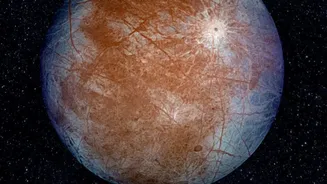
While REASON looks down, other sensors will build a complete picture of Europa's environment. The Europa Thermal Emission Imaging System (E-THEMIS) will act as a heat detector, scanning the surface for warm spots that could indicate recent eruptions of warmer water or cryovolcanic activity. The spacecraft’s main cameras, the Europa Imaging System (EIS), will map over 90% of the surface in stunning high resolution—down to just a few feet in some areas—revealing the complex geology of cracks, ridges, and chaotic terrain. Together, these instruments will help scientists understand the exchange of material between the ocean, the ice shell, and the surface, a key component in determining if the moon has the necessary ingredients for life: liquid water, chemistry, and energy.
Surviving the Jovian Gauntlet
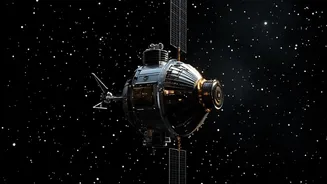
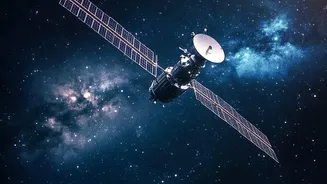
Operating a spacecraft near Jupiter is an immense engineering challenge. The planet's powerful magnetic field traps a donut of intense radiation, creating an environment that can destroy unprotected electronics. To survive this, Europa Clipper's most sensitive components and computers are housed inside a 1/3-inch-thick vault made of an aluminum-zinc alloy. With its solar arrays deployed, the spacecraft is over 100 feet wide—the size of a basketball court—making it one of the largest interplanetary probes NASA has ever built. These enormous arrays are needed to generate power so far from the sun. The mission's complex trajectory of long, looping orbits around Jupiter is specifically designed to dip into the high-radiation zone for quick flybys of Europa before retreating to a safer distance.