

The Gaze of a Dying Star
First, let's get our bearings. The Helix Nebula isn't a place where stars are born, but where they go to die. It's a planetary nebula, the beautiful aftermath of a star similar to our own sun reaching the end of its life. Over thousands of years, the dying
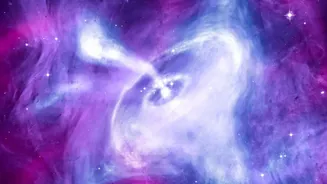
star puffed its outer layers of gas into space. The star's incredibly hot, leftover core, called a white dwarf, now sits at the center, blasting the surrounding gas with intense radiation and making it glow. This process creates the intricate, colorful rings we can see from Earth in the constellation Aquarius. It’s a breathtaking sight, but for decades, astronomers were puzzled by something strange lurking within this celestial smoke ring.
A Cosmic String of Pearls
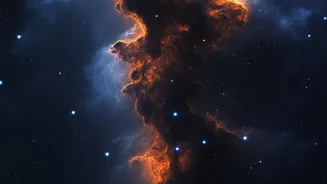
The mystery lies in what astronomers call “cometary knots.” These aren’t comets in the traditional sense, but massive, dense globules of gas and dust. There are tens of thousands of them scattered throughout the nebula. Though they look like tiny specks in images, each knot is colossal. The head of a single knot can be twice the size of our entire solar system, with a tail stretching for 100 billion miles. For a long time, their very existence was a puzzle. In the harsh, high-energy environment of the nebula, delicate molecules within these knots should be destroyed by the central star's radiation. Yet, they persist, holding pristine material from the star's final moments.
Mapping an Invisible Collision
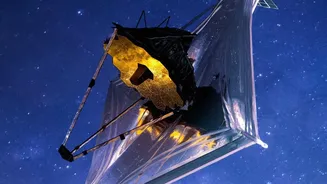
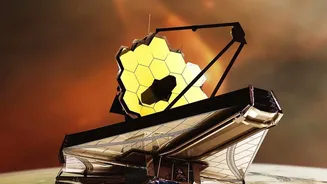
Recent observations, particularly from the James Webb Space Telescope, have provided a new level of clarity. It turns out these knots are not randomly distributed. Instead, many of them beautifully trace the inner rim of the expanding shell of gas. Think of it like this: the dying star didn't just puff out gas once. It ejected cooler, denser gas long ago, and is now blasting that material with a newer, faster, hotter wind. The collision between this fast wind and the old, slow gas is what fragments the cloud into the thousands of dense droplets we see as knots. They are essentially glowing buoys marking the shockwave from a stellar collision happening in slow motion over millennia.
Fossils of a Star's Finale
This discovery does more than just solve a long-standing riddle. These knots act as cosmic fossils. Because their dense cores protect the material inside from the central star’s harsh radiation, they preserve a chemical snapshot of what the star was made of. They are time capsules from a dying star, carrying clues about its life and death. By studying how these knots form and eventually dissipate, astronomers can better understand one of the most fundamental processes in the universe: stellar recycling. The material in this expanding shell, including the knots, will slowly mix with interstellar space, providing the raw ingredients—the gas and dust—for future generations of stars and planets. Looking at the Helix Nebula, we're not just seeing the end of one star; we're seeing the very beginning of the next cosmic chapter.