




The Sensational Arrival
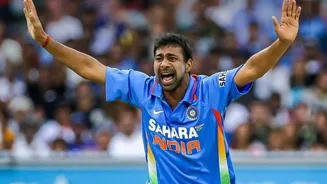
When a 19-year-old Irfan Pathan made his debut against Australia in 2003, he was a breath of fresh air. With a smooth action and the rare ability to swing the ball prodigiously both ways, he drew comparisons to the legendary Wasim Akram. His defining
moment came in 2006 against Pakistan in Karachi, where he took a hat-trick in the very first over of a Test match—a feat that remains unique in cricket history. He dismissed Salman Butt, Younis Khan, and Mohammad Yousuf in successive deliveries, cementing his status as India’s most exciting bowling talent. In his first two years, he was on a tear, becoming the fastest Indian to 100 ODI wickets at the time. The world was at his feet, and he seemed destined for a long and illustrious career.
The All-Rounder Conundrum
The arrival of Greg Chappell as India's coach in 2005 marked a significant turning point. Chappell saw immense batting potential in Pathan and promoted him up the order, sometimes even as an opener. The experiment yielded some success; Pathan scored a gritty 93 in a Test match and played several useful innings. However, this shift in focus is widely debated as a key reason for his decline. While Pathan himself has refuted the idea that Chappell 'ruined' his career, he acknowledged that the coach's aggressive style created insecurity in the team. The intense focus on becoming a batting all-rounder may have inadvertently diluted his primary weapon: his lethal swing bowling. As he spent more time honing his batting, his bowling seemed to lose its bite and, crucially, its pace.
The Inevitable Toll of Injuries
Perhaps the most significant factor in Pathan's downfall was a relentless series of injuries. Fast bowling is a punishing art, and Pathan's body began to break down. He suffered from back problems, knee injuries, and other recurring issues that forced him to spend long periods on the sidelines. These injuries robbed him of his pace and, more importantly, the rhythm required to generate swing. Pathan himself has pointed to injuries as the primary reason for his career stalling, stating that he was dropped from the team when he was injured and found it difficult to make a comeback. After one injury, he had to change his bowling action to put less pressure on his back, but this alteration affected his natural ability to move the ball. Each comeback saw him return as a slightly diminished version of his former self.
A Changed Bowler in a New Era
The post-injury Irfan Pathan was a different bowler. His pace, which was once in the 135-140 kph range, dropped significantly. Without that pace, his swing became less effective against top-class international batsmen. He began to concede runs at a higher rate and struggled for consistency. While he was a key part of India's victory in the inaugural 2007 T20 World Cup, where he was the Man of the Match in the final against Pakistan, his form in the longer formats remained patchy. In the meantime, Indian cricket was evolving. A new generation of bowlers emerged, and with the presence of other all-rounders, the competition for places became intense. The selectors and team management eventually looked past him, and his last appearance for India came in 2012 at the age of just 27.