





The Claim: A Shortcut to a Sharper Mind
The Hakini Mudra is a hand gesture from yogic tradition, often called the 'brain power mudra'. The central claim is that performing this simple gesture can significantly enhance cognitive functions. Proponents believe it improves memory, heightens concentration,
and fosters mental clarity. The gesture is named after the Hindu goddess Hakini, who is associated with the 'third eye' or Ajna chakra—the body's energy centre for intuition and intellect. The promise is alluring: that by simply pressing your fingertips together, you can synchronise the left and right hemispheres of your brain, leading to better decision-making and a more focused mind.
The Practice: How Hakini Mudra is Performed
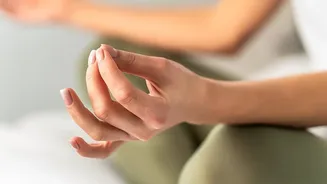
Performing the Hakini Mudra is straightforward. You bring the fingertips of your right hand to gently touch the corresponding fingertips of your left hand, keeping the palms separate to create a rounded, dome-like shape. The hands are often held at the level of the sternum or, during meditation, raised to the forehead to align with the third-eye chakra. It is typically practiced along with controlled breathing (pranayama) and is intended to draw a wandering mind back to a single point of focus. In yogic traditions, each finger is believed to represent one of the five elements (fire, air, space, earth, water), and the Hakini Mudra is unique in that it brings all five elements together, symbolising integration and holistic awareness.
The Search for Scientific Proof
When we move from ancient tradition to modern science, the evidence for Hakini Mudra's specific brain-boosting powers becomes thin. While there is a growing body of research on the neurological benefits of hand gestures (mudras) in general, specific, rigorous clinical trials on the Hakini Mudra are scarce. Most available literature discusses its benefits within the broader context of yoga and meditation, making it difficult to isolate the effect of the hand gesture alone. Some sources point to general neuroscience principles, suggesting that since hands have a large representation in the brain's sensory and motor cortices, any intentional hand gesture sends strong neural signals. However, these are broad correlations, not direct proof that touching fingertips enhances memory or synchronises brain hemispheres. The claims remain largely within the realm of traditional belief and anecdotal experience.
The Reality: What Neuroscience Actually Says
While neuroscience has shown that practices like Kirtan Kriya, which combines mudras with chanting, can activate regions of the brain like the prefrontal cortex, this is a multi-sensory activity. There is no credible scientific evidence to suggest that the physical act of performing Hakini Mudra by itself can create the profound neurological changes it claims, such as balancing the brain's hemispheres or directly boosting memory recall. Complex cognitive functions are the result of intricate neural networks and are better supported by proven methods like adequate sleep, nutrition, physical exercise, and continuous learning. While the idea of a 'brain power button' at our fingertips is appealing, current science does not support it.
The Indirect Benefit: Mindfulness and The Placebo Effect
So, is the Hakini Mudra useless? Not necessarily. Its true value may lie not in any mystical energy flow, but in its function as a tool for mindfulness. The act of consciously placing your hands in the gesture serves as a physical anchor to the present moment. This intentional pause can interrupt a racing mind, reduce stress, and encourage slower, deeper breathing—all of which are known to improve focus. Just a few minutes of mindfulness practice can enhance attentional control and reduce distractions. Therefore, any clarity or focus experienced while using Hakini Mudra is more likely attributable to the well-documented benefits of taking a mindful break, rather than the gesture itself having a direct, magical effect on the brain. It works because it prompts you to focus, not because it's a 'brain power' switch.