



The Cosmic Speed Limit
The secret to Webb’s time-traveling ability lies in a simple, fundamental truth: light takes time to travel. When you look at the Moon, you see it as it was 1.3 seconds ago. For the Sun, it's about eight minutes. For the nearest star, Proxima Centauri,
it's over four years. Light travels incredibly fast, at about 300,000 kilometres per second, but the universe is unimaginably vast. When astronomers talk about a galaxy being millions or billions of light-years away, they mean the light from that galaxy has travelled for that many years to reach us. Therefore, we are seeing the galaxy not as it is today, but as it was when that light began its journey. The JWST is designed to capture light that has been travelling for over 13 billion years, giving us a direct window into the cosmic dawn.
Seeing the Invisible: Webb's Infrared Vision
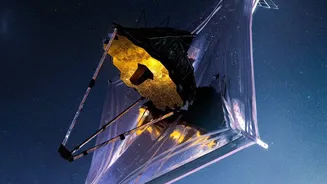
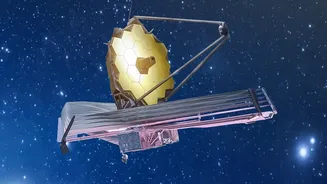
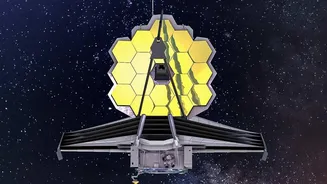
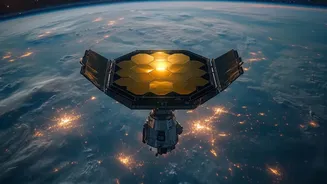
But seeing back in time isn't just about distance; it's also about seeing the right kind of light. The universe has been expanding since the Big Bang. As it expands, it stretches everything within it, including the waves of light travelling through space. This phenomenon is called 'cosmological redshift'. Light that was originally emitted from the first stars and galaxies as visible or ultraviolet light gets stretched over its billions-of-years journey into longer wavelengths, specifically into the infrared part of the spectrum. Human eyes can't see infrared light, and neither could the Hubble Space Telescope with the same clarity. The JWST, however, was built specifically to be a master of the infrared. Its giant mirror and sensitive instruments, like the Near-Infrared Camera (NIRCam) and Mid-Infrared Instrument (MIRI), are designed to capture this faint, ancient, and stretched-out light.
Deep Fields: A Glimpse of the Dawn
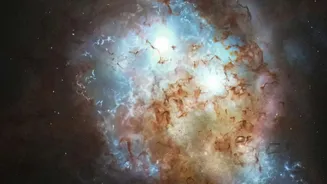
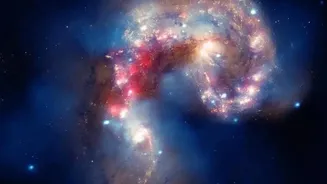
This is where the 'deep field' images come in. To create a deep field, astronomers point the telescope at a seemingly empty, tiny patch of sky—often described as the size of a grain of sand held at arm's length. By collecting light over many hours, Webb can reveal what's hidden in that darkness: thousands of galaxies. In its very first deep field image, focused on a cluster called SMACS 0723, the JWST captured the light of galaxies that existed when the universe was less than a billion years old. The image is a dizzying collage of galaxies from different eras. The bright white ones are part of the foreground cluster, which is 'only' 4.6 billion light-years away. But their immense gravity bends and magnifies the light from even more distant galaxies behind them, an effect called gravitational lensing, bringing otherwise invisible objects into view.
Rewriting Cosmic History
These images are more than just beautiful pictures; they are revolutionary data. By analysing the light with instruments like the Near-Infrared Spectrograph (NIRSpec), scientists can determine a galaxy's distance, age, and chemical makeup. Webb's observations have already challenged existing theories. Some of the earliest galaxies detected appear brighter, more structured, and more mature than models predicted. Objects known as 'little red dots' are baffling scientists, showing characteristics of both young galaxies and supermassive black holes, suggesting that the early universe was perhaps more active and complex than we ever imagined. It has found galaxies existing just 300-400 million years after the Big Bang, pushing the frontier of observation right to the edge of the 'Dark Ages' and helping us understand how the first stars lit up the cosmos.