



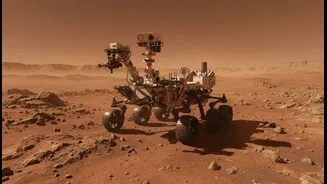


A Marathon on Another World
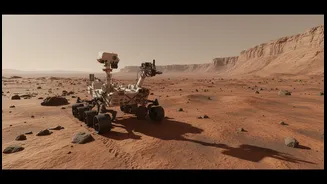
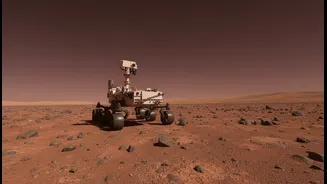
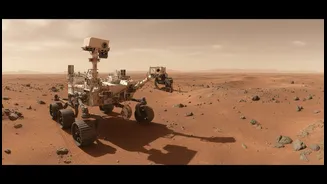
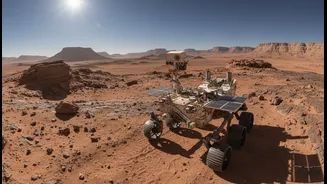
On June 14, 2026, the Perseverance rover surpassed 42.2 kilometers (26.2 miles) of travel since its landing in Jezero Crater in February 2021. While it's the second rover to achieve this feat after the long-serving Opportunity, Perseverance did it in record
time—just over five years compared to Opportunity's eleven. This impressive pace is not for sport; it’s a direct result of a new generation of technology designed to maximize scientific return. Every meter driven is a validation of the systems that will enable even more ambitious missions in the coming decades.
The Brains Behind the Drive: AutoNav
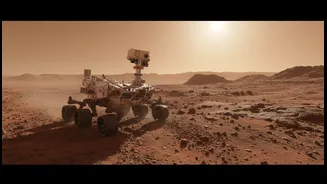
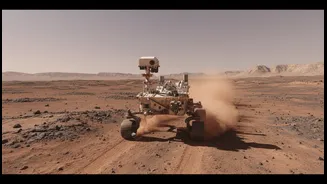
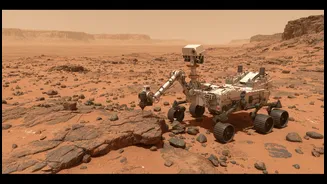
The key to Perseverance's speed and efficiency is its advanced autonomous navigation system, called AutoNav. Unlike older rovers that had to stop, take images, and wait for human operators on Earth to plot a safe path, Perseverance can 'think while driving'. Its dedicated computer brain processes stereo images in real-time, creating 3D maps of the terrain ahead to identify and steer around hazards like large rocks and sand pits on its own. While rover drivers at NASA's Jet Propulsion Laboratory still set the overall destination, they can now give the rover much greater freedom to manage the details of the journey. This has allowed Perseverance to navigate treacherous boulder fields and set single-day driving records, covering more ground to conduct science.
Humans in the Loop, Millions of Miles Away
Despite its autonomy, Perseverance is a partnership between robot and human. A team of rover planners on Earth uses 3D images to map out general routes and identify scientifically interesting targets. They send a full day's worth of commands to the rover, which then executes the plan, using AutoNav to handle the fine-grained driving decisions. This method is essential due to the communication delay between Earth and Mars, which can be as long as 20 minutes each way, making real-time 'joysticking' impossible. Recently, this process has been enhanced by technologies like Mars Global Localization, which allows the rover to pinpoint its exact location without human help, and even experiments with AI to help select waypoints, further streamlining operations.
Built to Endure the Red Planet
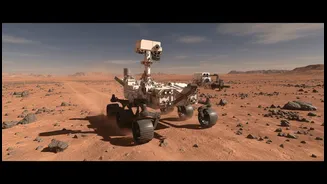
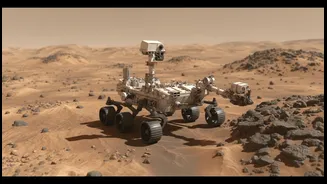
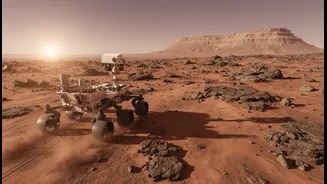
Covering marathon distances on Mars requires hardware that can withstand the punishing environment. Learning from the experiences of the Curiosity rover, whose wheels sustained significant damage from sharp rocks, engineers equipped Perseverance with more robust wheels. Perseverance's wheels are made of aluminum with titanium spokes for support. They are thicker, have a larger diameter, and feature a different tread pattern with twice as many cleats for better traction and durability. This improved design has allowed the rover to confidently traverse the varied and often hazardous terrain of Jezero Crater and beyond, ensuring the mission's longevity and ability to reach its scientific goals.
Paving the Way for Mars Sample Return
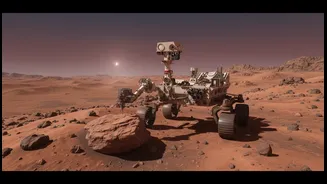
Ultimately, Perseverance is a pathfinder. Each of its technological advancements serves a greater purpose: preparing for the Mars Sample Return (MSR) campaign. This ambitious multi-mission effort, a partnership between NASA and the European Space Agency, aims to bring the rock and soil samples collected by Perseverance back to Earth for detailed study. The success of Perseverance's autonomous navigation, its robust hardware, and its efficient operations provides critical data and confidence for designing the future landers and rovers needed for MSR. For instance, a smaller, quicker Sample Fetch Rover is planned to retrieve the samples Perseverance has cached. By proving these technologies on the Martian surface today, Perseverance is directly enabling the next giant leap in our exploration of the Red Planet.