







What is Aphelion?
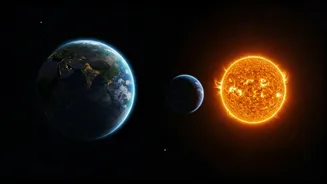
On July 6, 2026, our planet reaches a special point in its annual journey called aphelion. The term comes from the Greek words 'apo' (meaning away) and 'helios' (meaning sun). It marks the moment when Earth is at its greatest distance from the Sun for
the year. Earth’s orbit is not a perfect circle; it’s a slight ellipse. This means our distance from the Sun varies. At aphelion in 2026, we will be about 152.1 million kilometres away from our star. The opposite of aphelion is perihelion (from 'peri' meaning close), which happened in early January 2026, when Earth was at its closest point to the Sun, at about 147.1 million kilometres. That’s a difference of around 5 million kilometres.
The Great Seasonal Misconception
It’s intuitive to think that being farther from the Sun should mean colder weather. Many people assume our distance from the Sun causes the seasons — closer means summer, and farther means winter. However, aphelion occurs every year in early July, right in the middle of summer for the Northern Hemisphere. This simple fact is the most powerful piece of evidence that the distance-to-sun theory is incorrect. If distance were the primary factor, July should be our coldest month, not one of our warmest. The truth is that the variation in distance, which is only about 3%, has a very small effect on our overall climate compared to another, much more significant factor.
The Real Reason for the Seasons
The true cause of Earth's seasons is the tilt of our planet's axis. Earth is tilted at an angle of about 23.5 degrees relative to its orbital plane. As we orbit the Sun, this axis always points in the same direction in space, towards the North Star. During the Northern Hemisphere's summer, the northern half of the planet is tilted toward the Sun. This means the Sun's rays hit this part of Earth more directly, like a flashlight shining straight down on a surface. This direct energy is more concentrated and intense, leading to warmer temperatures. Additionally, the tilt means longer daylight hours, giving the Sun more time to heat the land and sea. When it’s summer here, the Southern Hemisphere is tilted away from the Sun, receiving less direct, more spread-out sunlight, and experiencing winter.
A Matter of Angles, Not Miles
Think of it this way: the angle of sunlight is far more important than the slight change in distance. In winter, the sun's rays strike us at a shallower angle, spreading the same amount of energy over a much larger area, making it less effective at heating the ground. The difference in energy received between direct summer sun and slanted winter sun is dramatic. The roughly 7% drop in solar energy we get at aphelion compared to perihelion is a minor effect, easily overshadowed by the massive impact of the axial tilt. In fact, the entire Earth is slightly warmer when it is farther from the sun in July, partly because the Northern Hemisphere, which has more landmass that heats up easily, is pointing towards the sun.