








Understanding the Instinctive Behavior
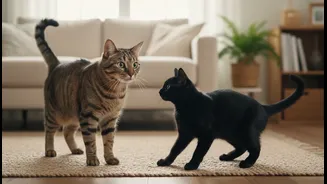
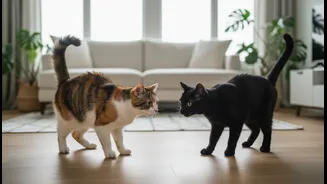
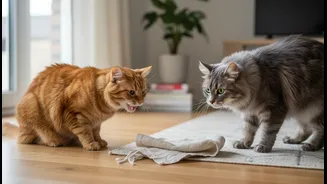
When a cat guards their food, it’s easy to interpret the hissing and growling as greed or meanness. However, this behavior is driven by a powerful, ancient survival instinct. The ancestors of domestic cats were solitary hunters who had to protect every
meal from competitors to survive. This instinct doesn't disappear just because they live indoors where food is plentiful. In the close quarters of an apartment, this behavior can be amplified. Cats may perceive a housemate as a direct competitor for a vital resource, triggering defensive, territorial actions. Understanding that this is rooted in instinct, not malice, is the first step toward compassionately managing the problem.
The First Step: Create Safe Feeding Zones
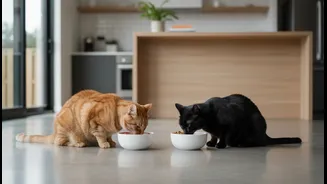
The most immediate and effective way to stop food-related fights is to create total separation during meals. This is not a punishment, but a way to reduce stress and give each cat a sense of security. Feed your cats in separate rooms with the doors closed. If separate rooms aren't an option in a smaller apartment, create visual barriers. Place their bowls far apart, facing away from each other, or around a corner so they cannot make eye contact while eating. Some owners have success feeding one cat on an elevated surface like a counter or cat tree that the other cat can't easily access. The goal is to eliminate the feeling of competition, allowing each cat to eat peacefully without fear of their food being stolen. Collect the bowls after about 20-30 minutes to remove any lingering temptation for a dominant cat to inspect the other's leftovers.
The Art of Counter-Conditioning
Once you have established safe, separate feeding routines, you can begin the process of changing your cats' emotional responses. This is where behavioral conditioning comes in. The goal is to use a technique called counter-conditioning, which teaches your cats to associate each other’s presence with a positive experience, rather than a threat. You are essentially rewiring the association from "other cat equals competition" to "other cat equals good things happen." This is often done using high-value treats—something your cats love even more than their regular food. The key is to reward calm behavior in the presence of the other cat, slowly teaching the guarding cat that the other's proximity predicts a reward, not a conflict.
A Guide to Gradual Desensitization
Desensitization is the process of gradually and slowly re-exposing a cat to a trigger at a level that doesn't provoke anxiety. When combined with counter-conditioning, it’s a powerful tool. Start by feeding the cats on opposite sides of a closed door. They can smell each other but not see or interact. After several successful sessions with no signs of stress, you can progress to using a baby gate or cracking the door open just an inch. The next step might be a baby gate with a blanket over it, which you slowly raise over many sessions. Each step should be so small that the cats remain calm or 'below threshold'. During this process, offer praise and high-value treats to reinforce the positive association. If at any point a cat shows signs of stress like growling, hissing, or staring, you have moved too fast. Simply go back to the previous step where they were comfortable and proceed more slowly.
Consistency and Other Important Factors
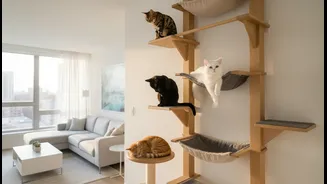
Success depends on absolute consistency. Stick to a regular feeding schedule so your cats learn to feel secure that food will arrive predictably. Irregular feeding times can increase anxiety and competition. Beyond mealtime, ensure your apartment is a place of abundance. According to the "N+1" rule, you should have one resource per cat, plus one extra. This applies to litter boxes, water bowls, scratching posts, and resting spots. Spreading these resources throughout your home prevents one cat from monopolizing them and helps reduce overall territorial stress. Some cats also benefit from puzzle feeders, which slow down their eating and engage their hunting instincts, making mealtime a satisfying activity rather than a race.