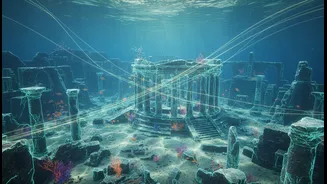









The Enduring Legend of Seven Pagodas
The story is as timeless as the sea itself. Ancient lore, noted by European sailors centuries ago, speaks of seven magnificent temples, or pagodas, that once lined the coast of Mahabalipuram. These temples were said to have served as a landmark for mariners,
their glittering tops visible from far out at sea. But according to the legend, the gods grew jealous, and a great deluge swallowed six of the seven temples, leaving only the iconic Shore Temple standing as a solitary survivor on the coast. For generations, local fishing communities have passed down stories of glimpsing the submerged ruins glittering beneath the waves on clear days, a tantalizing hint of a grander complex lost to time. While the Shore Temple, a UNESCO World Heritage site, stands as a testament to the Pallava dynasty's architectural prowess, the tale of its six sunken siblings has remained one of India's most compelling historical mysteries.
A New Technological Quest
After nearly two decades, the quest to solve this riddle has been renewed with fresh vigour. The Archaeological Survey of India’s (ASI) Underwater Archaeology Wing has resumed explorations off the Mahabalipuram coast, deploying a new generation of technology to peer into the ocean's depths. This new phase of fieldwork is being powered by advanced tools, including sophisticated sonar systems and Remotely Operated Vehicles (ROVs). These unmanned submersibles can navigate challenging underwater environments to capture high-resolution images and videos of submerged remains without disturbing the delicate archaeological site. This represents a significant leap forward from past efforts, allowing archaeologists to map the seabed with unprecedented accuracy and safety. The goal is to systematically document any anomalies or man-made structures and build a comprehensive picture of what may have once been a bustling part of this ancient port city.
Echoes from the Deep: Past Discoveries
This latest expedition does not start from scratch. It builds on a foundation of intriguing discoveries made over the past two decades, many of which were spurred by a natural disaster. The 2004 Indian Ocean tsunami provided a dramatic, if tragic, clue. As the sea pulled back an estimated 500 meters from the shore, eyewitnesses reported seeing a long, straight row of large stone boulders emerge from the water before being submerged again. Subsequent explorations by the ASI and the Indian Navy confirmed these were not natural formations. Using sonar, they mapped what appeared to be a 70-meter-long wall and the remains of other temples and a cave temple, all within 500 meters of the shore. Explorations as early as 2002, by teams from the National Institute of Oceanography (NIO), had already found submerged walls and stone blocks at depths of 5 to 8 meters, which were dated to the Pallava era. These findings collectively suggest that the Shore Temple was not an isolated structure, but part of a much larger coastal complex.
From Myth to Documented History
The significance of this underwater search extends far beyond simply proving or disproving a legend. If the surveys can confirm the existence of a widespread, submerged settlement, it would revolutionise our understanding of the Pallava dynasty and ancient maritime history. Mahabalipuram was a major port city, and uncovering its submerged portions could provide invaluable insights into its urban planning, trade connections, and the reasons for its demise. Archaeologists believe the structures, estimated to be between 1,100 to 1,500 years old, were likely submerged over time due to a combination of sea-level rise and coastal erosion. Each discovered wall, pillar, and stone block is a piece of a puzzle. By piecing them together, researchers hope to reconstruct the layout of this lost part of the city, transforming what has been passed down through folklore into a documented chapter of Indian history.