




A Groundbreaking Return
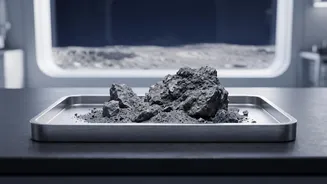
In a landmark achievement for space exploration, China's Chang'e-6 mission successfully returned to Earth in 2024 with nearly two kilograms of rock and soil from the Moon's far side. For decades, our entire physical collection of lunar material—from both
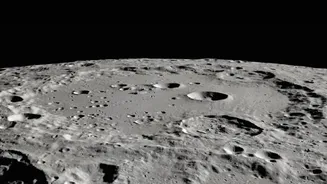
the Apollo and Soviet Luna missions—came exclusively from the near side. The Chang'e-6 samples were collected from the vast South Pole-Aitken (SPA) basin, the oldest and largest impact crater on the Moon. This provided a historic opportunity for scientists to get their hands on pristine material from a completely different geological province, promising to answer long-standing questions about why the Moon has two distinct faces.
The Moon's Two Faces
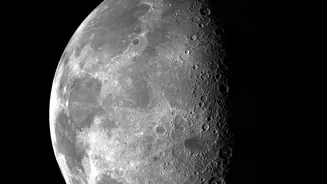
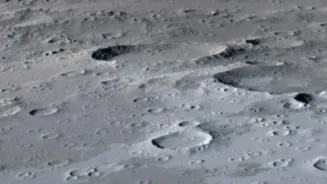
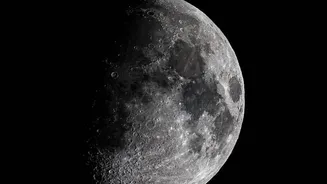
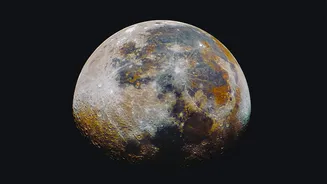
The Moon is tidally locked with Earth, meaning it always presents the same hemisphere toward us. The near side is characterized by vast, dark plains of basalt called 'maria' or seas. These are the remnants of ancient lava flows. The far side, in contrast, is almost entirely covered in heavily cratered, brighter highlands and has a much thicker crust. Scientists have long debated the cause of this asymmetry. A leading explanation was simply that the thicker far side crust made it harder for molten rock from the interior to erupt onto the surface. But the new samples are providing a much more detailed picture.
An Ancient Ocean of Magma
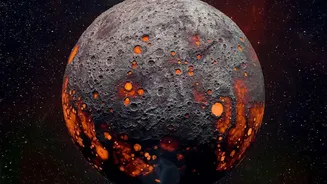
The dominant theory of the Moon's formation suggests it was once covered by a global ocean of molten rock. As this 'lunar magma ocean' cooled and crystallized over millions of years, lighter minerals floated to the top to form the crust, while denser minerals sank. During this process, a unique geochemical component rich in potassium (K), rare-earth elements (REE), and phosphorus (P)—collectively known as KREEP—was concentrated in the final dregs of the magma. This KREEP material also contains heat-producing radioactive elements like thorium, which are heavily concentrated on the near side and are thought to have kept it volcanically active for much longer.
Clues in the New Rocks
Initial analysis of the Chang'e-6 samples confirms the far side's unique history. The basalt fragments show evidence of volcanic activity but are compositionally different from near-side basalts. Crucially, they originated from a mantle source that is extremely low in the incompatible elements that make up KREEP. Research from Nanjing University also found that while the deep mantle material seems chemically similar on both sides, the crustal rocks on the far side are richer in magnesium. This suggests that the processes building the crust were different on each hemisphere, even if they drew from a similar deep source.
Connecting Magma Movement to the Mystery
The latest research combines these findings into a compelling new model. After the Moon became tidally locked with Earth, the near side experienced stronger tidal heating from Earth's gravity. This uneven heating could have driven vast, hemisphere-scale currents within the cooling magma ocean. These flows may have transported early-forming, magnesium-rich crustal materials toward the far side, effectively thickening its crust. At the same time, this process would have concentrated the remaining, KREEP-rich molten material on the near side. This would explain both the thicker, KREEP-poor crust of the far side and the thinner, volcanically active crust of the near side, providing a powerful explanation for the Moon's two-faced nature.