





A Cosmic Discovery at the Dawn of Time
Astronomers have announced the discovery of the oldest and most compact pair of quasars ever seen, shining brightly just 900 million years after the Big Bang. The discovery was made using data from the James Webb Space Telescope (JWST) and confirmed with
the Gemini North telescope in Hawai'i. This pair of cosmic beasts, officially known as J1602+4228AB, has been given the Hawaiian nickname Nāpōwawāʻenakaulua, meaning 'Two celestial bodies of fathomless powerful darkness in the brilliance of heat reincarnating energy into the Universe'. This finding is not just a record-breaker; it presents a profound puzzle that challenges the very foundation of how we think the first galaxies and black holes formed.
What Exactly is a Quasar?
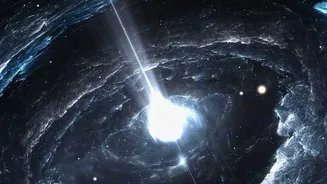
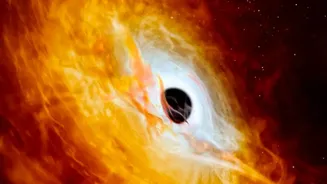
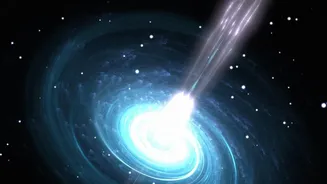
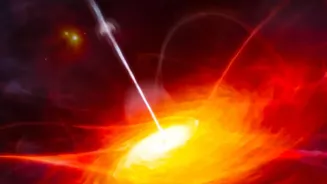
Think of a quasar as a cosmic lighthouse powered by a monster. At the heart of most large galaxies, including our own Milky Way, lies a supermassive black hole. Most of the time, these giants are dormant. But when a galaxy is rich in gas and dust, this material can fall toward the black hole, forming a swirling, superheated disc around it. This process releases an incredible amount of energy, causing the disc to glow so brightly it can outshine all the stars in its host galaxy combined. This intensely luminous object is what we call a quasar. Because they are so bright, quasars act as cosmic beacons, allowing astronomers to study the conditions of the very early universe.
Why Finding Two is So Special
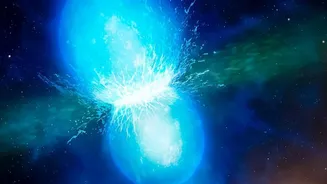
While finding a single quasar from this early epoch is a challenge, finding a pair so close together is a game-changer. Quasar pairs are considered the smoking gun for galaxy mergers. When two galaxies collide, their central supermassive black holes are drawn toward each other. For a brief period, both can be actively feeding and shining as quasars before they eventually combine. This new discovery shows two such objects separated by only 18,100 light-years—about a fifth of the diameter of our Milky Way. It provides direct evidence that massive galaxies were already crashing together and merging during the universe's infancy, a key process in building the large-scale cosmic structures we see today.
The Problem of Being Too Big, Too Soon
The existence of Nāpōwawāʻenakaulua so early in cosmic history is what truly stuns astronomers. According to current models of cosmology, black holes need time to grow. They start from smaller 'seeds' and gradually gain mass by consuming matter or merging with other black holes. The two black holes powering this quasar pair are enormous, with masses of 1.5 billion and 400 million times that of our sun, respectively. Simply put, there shouldn't have been enough time in the 900 million years since the Big Bang for them to have grown this massive. As lead researcher Silvia Onorato stated, 'There is no definitive theoretical explanation for how a single one of these giant quasars exists so early in the age of our Universe, much less two'.
A New Chapter for the Webb Telescope
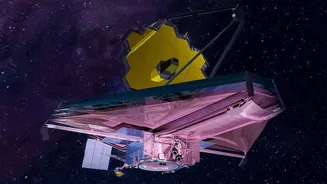
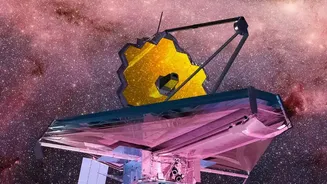
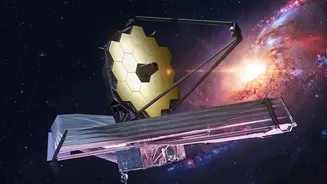
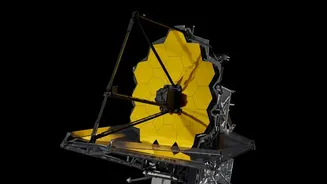
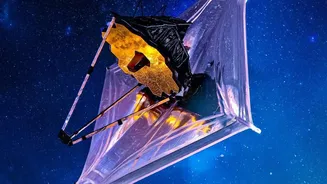
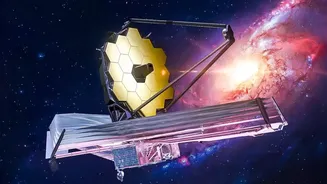
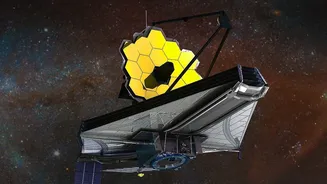
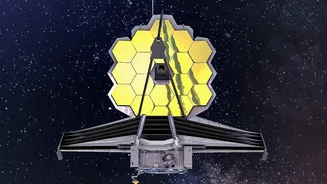
This discovery would not have been possible without the unique capabilities of the JWST. Its power to see in infrared light allows it to peer through cosmic dust and capture the faint light from the most distant objects in the universe. The quasar pair was first identified in data from JWST’s Aether survey, a program designed to take a census of the early universe. While Webb identified the candidate, follow-up observations with the ground-based Gemini North telescope were crucial to visually separate the two distinct points of light and confirm they were indeed a pair. This synergy between space and ground-based observatories is pushing the boundaries of what we can see. The finding suggests that the early universe was a much more chaotic and rapidly evolving place than previously thought, with galaxy mergers and black hole growth happening faster than our theories allowed.