






What is GISAT-1A?
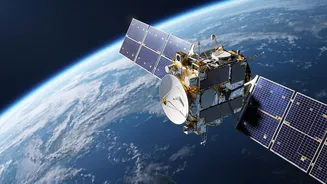
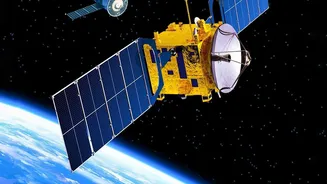
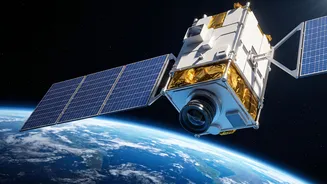
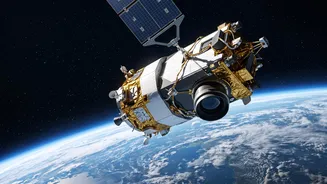
GISAT-1A, also known as EOS-05, is an advanced Earth-observation satellite designed by ISRO. Unlike most observation satellites that circle the Earth in a polar orbit and see a particular spot for only a few minutes a day, GISAT-1A is destined for a geostationary
orbit, approximately 36,000 kilometres high. At this altitude, the satellite moves in sync with the Earth's rotation, allowing it to remain almost stationary over the Indian subcontinent. This unique perch gives it the ability to provide continuous, near real-time imagery of a huge area, making it a persistent 'eye in the sky' for India. The satellite weighs over 2,200 kg and is equipped with powerful multi-spectral and hyperspectral imaging instruments.
Why is this satellite so important?
The strategic and civilian applications of GISAT-1A are vast. Its key advantage is 'high temporal resolution'—the ability to revisit a location very quickly. The satellite is designed to be capable of imaging the entire Indian landmass every half-hour, and it can be steered to focus on a specific area of interest for a new image every five minutes. This is a game-changer for disaster management, enabling real-time tracking of cyclones, floods, forest fires, and other rapidly evolving events. For national security, it offers constant surveillance over border areas and the surrounding oceans, a significant upgrade for monitoring and strategic planning. Additionally, its data will support agriculture, forestry, and water resource management.
What happened to the first GISAT mission?
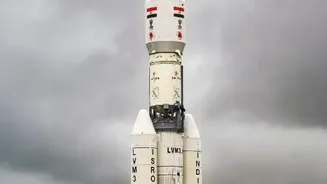
This mission carries the weight of a past failure. The predecessor satellite, GISAT-1 (also called EOS-03), was lost during its launch in August 2021. The launch vehicle, a GSLV-F10 rocket, performed normally through its first two stages. However, the mission failed when the crucial third stage—the cryogenic upper stage—did not ignite. An investigation later revealed that a technical anomaly involving a leaking valve caused a pressure drop in the liquid hydrogen tank, preventing the engine from starting. The rocket couldn't achieve the necessary velocity, and the satellite was lost. The GISAT-1A mission is ISRO's second attempt to place this powerful capability in orbit.
What are the challenges this time?
The pressure on ISRO for this launch is immense, as it comes after a series of setbacks. In 2025 and early 2026, ISRO experienced two consecutive failures of its otherwise reliable PSLV rocket, which led to a pause in launch operations for several months while investigations were conducted. Furthermore, a navigation satellite launched in 2025, NVS-02, reached its initial orbit but failed to make it to its final slot due to an issue with its own thrusters. The GISAT-1A mission is not just about deploying a satellite; it's about restoring confidence in the GSLV Mk-II rocket, particularly its cryogenic stage, which is vital for launching heavier payloads to high orbits. A successful launch would signal that ISRO has overcome the technical hurdles and is back on track.
When will it launch?
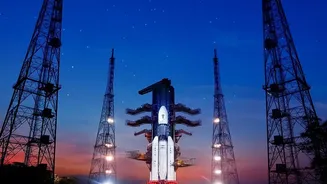
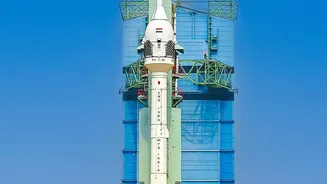
ISRO is targeting the first week of September 2026 for the launch of GISAT-1A. Recent reports from late August 2026 confirm that the GSLV-F17 rocket, carrying the satellite, has already been moved to the second launch pad at the Satish Dhawan Space Centre in Sriharikota. This move is standard procedure, typically occurring about a week before the scheduled lift-off. The launch, set for September 4, will mark ISRO's return to orbital missions after a seven-month hiatus and is a critical step towards re-establishing its launch cadence.