






A Landmark Discovery
Scientists have announced the detection of minerals that can only form in the presence of liquid water within dust grains originating from the Kuiper Belt. This remote, icy region beyond Neptune's orbit was long considered a frozen, static graveyard of planetary
formation. The new findings, however, suggest a more dynamic past. The study indicates that the parent bodies of this dust—small, icy worlds known as Kuiper Belt Objects (KBOs)—likely experienced conditions warm enough to sustain liquid water at some point in their history. This discovery fundamentally alters our perception of these distant objects, suggesting they are not just inert ice balls but complex worlds with intriguing geological histories.
Reading the Story in Dust
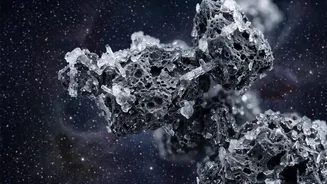
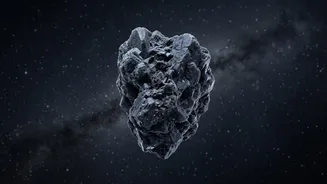
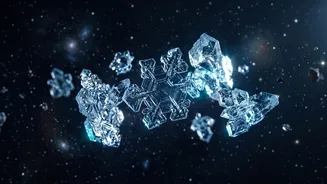
The evidence comes from analyzing interplanetary dust particles, tiny specks of material shed from comets and asteroids that drift through our solar system. Scientists can collect and study these grains to learn about their parent bodies. Using advanced laboratory techniques, researchers examined dust believed to originate from KBOs. They found that the grains contained not only water-ice but also specific types of minerals that are known to be formed through interactions with liquid water. Furthermore, the water molecules found within these minerals have a unique isotopic signature, a kind of chemical fingerprint, suggesting they came from a reservoir that was separate from the water in the inner solar system.
How Can a Frozen World Have Liquid Water?
The immediate question is how liquid water could have existed in a region where temperatures hover around a frigid -223 degrees Celsius. The answer may lie deep inside these icy worlds. Scientists theorize that heat generated by the decay of radioactive elements, a process called radiogenic heating, could have warmed the interiors of larger KBOs. This internal heat could have been sufficient to melt ice and maintain a subsurface ocean or pockets of liquid water for millions of years. Recent studies of dwarf planets like Eris and Makemake in the Kuiper Belt have also pointed to signs of geothermal activity, lending weight to the idea that these are not entirely frozen worlds.
Cosmic Fossils and the Origin of Earth's Oceans
KBOs are considered pristine remnants from the formation of our solar system, essentially cosmic fossils that hold clues about its earliest conditions. For decades, a leading theory for how Earth got its vast oceans is that water was delivered by comets and asteroids bombarding the young planet. Many comets are believed to originate in the Kuiper Belt. The discovery of water in the very building blocks of these objects strengthens this connection. If the raw materials in the outer solar system were water-rich, it becomes more plausible that impacts from these bodies seeded the early Earth with the water necessary for life to emerge. The unique isotopic signature found in the Kuiper Belt dust could help scientists trace the origins of Earth's water more precisely.
What Comes Next in the Search for Water
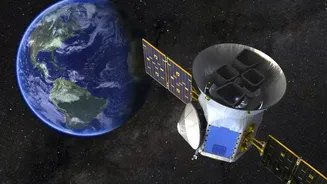
This discovery opens up exciting new avenues for research. It highlights the Kuiper Belt as a high-priority target for future exploration. While NASA's New Horizons spacecraft gave us our first close-up look at Pluto and another KBO named Arrokoth, there are millions more of these objects waiting to be studied. Scientists will now be eager to use powerful instruments like the James Webb Space Telescope to search for more evidence of water-altered minerals on the surfaces of other KBOs. Ultimately, a mission designed to sample a KBO and return that material to Earth would provide definitive answers about its history and composition, and perhaps solve the long-standing mystery of where our own planet's water came from.