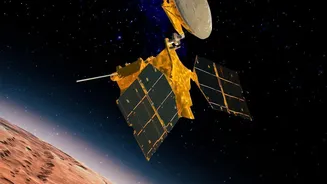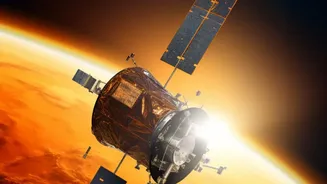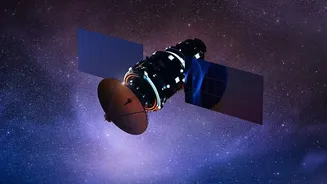






From Data Relay to Orbital Brain
Traditionally, satellites operated on a simple model: collect vast amounts of raw data—like images of Earth—and beam it all back to ground stations for processing. This 'bent pipe' approach is becoming a bottleneck. Modern satellites can generate terabytes
of data daily, overwhelming limited communication bandwidth and creating significant delays. An AI satellite flips this model on its head by embedding powerful processors and machine learning algorithms directly onboard. This is a form of 'edge computing,' where data is analyzed at its source instead of being sent elsewhere for processing. Instead of just collecting and forwarding information, these satellites can understand it, deciding what's important, what to discard, and even what to act on autonomously.
The Power of Real-Time Decisions
The most significant change AI brings to space is the reduction in latency—the delay between data collection and actionable insight. For time-sensitive events like monitoring wildfires, floods, or illegal maritime activity, waiting hours for a satellite to pass over a ground station is no longer viable. An AI-powered satellite can analyze imagery as it's captured, detect a fire's signature, and immediately send a focused alert through a low-bandwidth channel. This shrinks response times from hours or even days to mere minutes. This capability also allows satellites to operate more efficiently. For instance, AI can identify when cloud cover is obscuring the view and avoid capturing useless imagery, saving power and storage.
Smarter, More Autonomous Operations
With thousands of active satellites already in orbit and tens of thousands more planned, manual control by ground crews is becoming impossible. AI is stepping in to manage these growing constellations. AI systems can autonomously handle complex tasks like optimizing communication routes, managing network traffic, and maintaining orbital positions. Crucially, they can also predict and avoid potential collisions with space debris, a critical safety function in an increasingly crowded orbital environment. Companies like SpaceX are already using AI to manage the orbital positioning and communication links for their Starlink constellation. This level of autonomy makes satellite networks more resilient and reduces the immense operational burden on human engineers.
The Rise of Orbital Data Centers
Looking ahead, the integration of AI is paving the way for an even more futuristic concept: massive data centers in space. The insatiable energy demands of terrestrial AI data centers are a growing concern. Space offers a compelling alternative with abundant, uninterrupted solar power and the natural vacuum for efficient cooling, which eliminates the need for the energy-intensive cooling systems used on Earth. Companies like SpaceX and Blue Origin, alongside startups like Starcloud, are actively developing plans for constellations that would function as orbital compute platforms. These orbital data centers could one day handle large-scale AI model training and other intensive computing tasks, offloading the immense infrastructural strain from Earth's power grids.