
The Cosmic Barcode of an Atmosphere
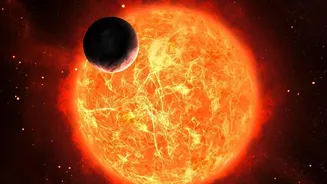
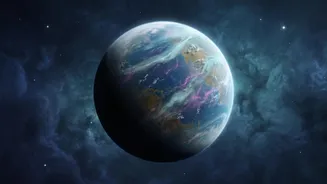
The foundational technique JWST uses is called transmission spectroscopy. It sounds complex, but the idea is elegant. When an exoplanet passes in front of its host star from our point of view—an event called a transit—a tiny fraction of the starlight
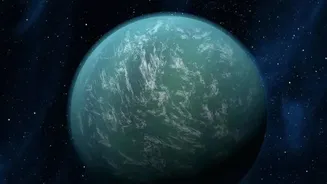
filters through the planet's atmosphere. Different gases in that atmosphere absorb specific wavelengths, or colours, of light. This process leaves a unique pattern of missing light, creating a chemical 'fingerprint' or 'barcode' in the starlight that reaches the telescope. By analysing this barcode, astronomers can definitively identify the molecules present in that alien air, including the all-important signature of water vapour.
The Power of Seeing in Infrared
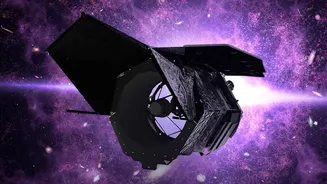
Previous observatories, like the Hubble Space Telescope, could perform spectroscopy, but JWST has a distinct advantage: it is designed specifically to see the universe in infrared light. This is a game-changer for several reasons. First, many key molecules associated with life, such as water, methane, and carbon dioxide, leave their most prominent and readable signatures in the infrared part of the spectrum. Second, infrared light can better penetrate the cosmic dust and haze that might otherwise obscure a planet’s atmosphere, giving scientists a clearer view. This specialised vision allows JWST to detect even faint traces of these compounds with a clarity that was previously impossible.
A Revolutionary Toolkit for Astronomers
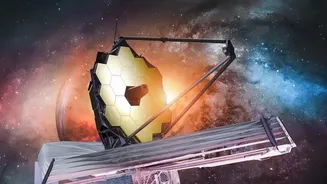
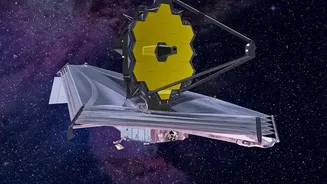
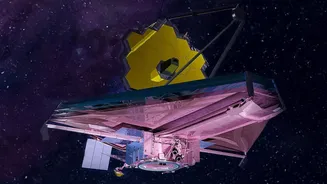
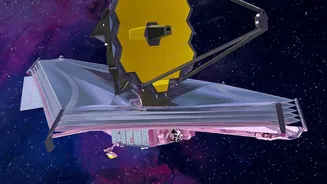
JWST’s superiority isn’t just about its infrared focus; it's also about raw power and precision. Its massive 6.5-metre primary mirror, nearly three times wider than Hubble's, collects far more light, enabling it to study smaller planets and
From Data to Groundbreaking Discoveries
The theoretical power of JWST is already yielding stunning results. In a landmark observation, the telescope detected water vapour in the inner disk of a young star system called PDS 70. This discovery is significant because it's the region where rocky, Earth-like planets are thought to form, suggesting that the building blocks for life could be available from the very beginning of a planet's creation. In another case, JWST studied the atmosphere of WASP-107b, a 'fluffy' gas giant, and found not only water vapour but also surprising clouds made of sand and the presence of sulfur dioxide. These findings showcase JWST's ability to reveal the complex and dynamic weather systems on worlds unlike anything in our solar system.
Beyond Just Finding Water
Detecting water vapour is a monumental step, but it is only the first piece of the puzzle. The ultimate goal is to build a complete chemical inventory of an exoplanet's atmosphere to assess its potential for habitability. JWST’s spectroscopic toolkit allows scientists to hunt for a whole range of potential biosignatures—gases that could hint at biological processes. The presence of water combined with molecules like methane, oxygen, and carbon dioxide in certain ratios could point toward a world with an active biosphere. By comparing the atmospheric compositions of hundreds of different planets, from hot Jupiters to potentially rocky worlds, astronomers are beginning to understand the diversity of planets in our galaxy and what makes a world truly habitable.