





Peering Through an Alien Sky
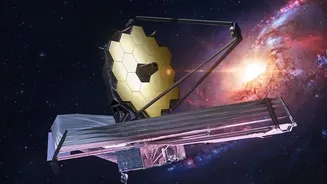
Imagine trying to figure out the composition of the air in a city hundreds of kilometres away, just by looking at the light shining through it. That, in a nutshell, is what the James Webb Space Telescope does for exoplanets—planets orbiting other stars.
The technique is called transmission spectroscopy. When an exoplanet passes in front of its star from our perspective (an event called a transit), the starlight filters through the planet's atmosphere. Different gases and molecules in that atmosphere absorb specific colours, or wavelengths, of light. This leaves a unique chemical fingerprint on the light that ultimately reaches the telescope's sensitive instruments. By analysing this fingerprint, which scientists call a spectrum, we can decode the atmospheric makeup of a world light-years away.
JWST: A Master of Light
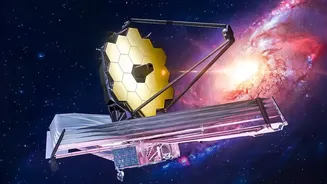
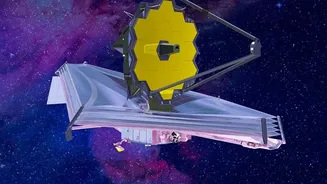
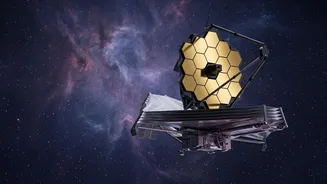
While the Hubble Space Telescope could also perform this kind of analysis, JWST is in a class of its own. Its massive mirror and specialisation in infrared light give it extraordinary sensitivity. Infrared is key because it is particularly good for detecting molecules like water, methane, and carbon dioxide. These molecules absorb infrared light in very distinct ways, creating clear dips in the spectrum that JWST's instruments, like the Near-Infrared Spectrograph (NIRSpec), can measure with high precision. For the first time, astronomers can detect even subtle traces of these compounds, which was incredibly difficult or impossible before. This has opened a new era in exoplanet science, allowing us to study the atmospheres of smaller, rocky planets, not just the gas giants that were easier targets.
Case Study: The 'Steam World' of GJ 9827 d
One of the most stunning examples of JWST's power is the recent analysis of GJ 9827 d, an exoplanet about 100 light-years away. Initial hints of water came from Hubble, but it was JWST's superior observations that confirmed the planet's atmosphere is composed almost entirely of hot water vapour. This led scientists to dub it a 'steam world.' While the planet itself is too hot to be habitable for life as we know it, this discovery is monumental. It is the first observational proof that planets with water-rich atmospheres, long theorised by astronomers, actually exist. Finding and confirming such a world is a huge step toward identifying other planets, perhaps more temperate ones, where we can search for biosignatures in the future.
Not Just Vapour, But Where It Comes From
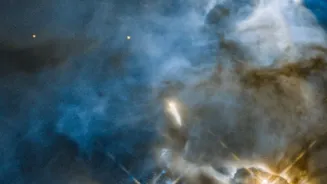
JWST's work goes beyond simply detecting water. In one groundbreaking discovery, the telescope found water vapour in the inner region of a planet-forming disk around a young star called PDS 70. This region is where rocky planets like Earth are thought to form. The finding suggests that water is available as a core ingredient during the planet-building process, not just delivered later by comets and asteroids. On other planets, like the scorching-hot gas giant WASP-18 b, JWST has detected water despite temperatures that should tear the molecules apart. This speaks to the telescope's incredible sensitivity and provides data that helps scientists refine their models of planetary formation and atmospheric chemistry. Even when the data is ambiguous, as with the rocky planet GJ 486 b where water vapour signals could be from the star itself, it pushes the boundaries of scientific inquiry.