





What Is the Habitable Zone?
In the search for life beyond Earth, the term ‘habitable zone’ is a rock star. Also known as the 'Goldilocks Zone,' it refers to the orbital region around a star where conditions are theoretically right for a planet to have liquid water on its surface.
This is based on a simple but powerful idea: life as we know it requires liquid water. Too close to its star, and a planet's water would boil away. Too far, and it would freeze solid. The habitable zone is that sweet spot in between. The size and location of this zone depend entirely on the star. A bright, hot star has a wider habitable zone that is farther out, while a dim, cool star has a much tighter one closer in. For decades, this has been astronomers' primary tool for flagging exoplanets—planets outside our solar system—as 'potentially habitable'.
Our Solar System's Paradox
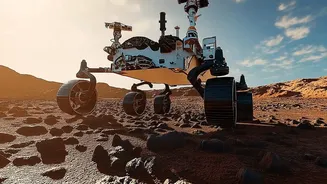
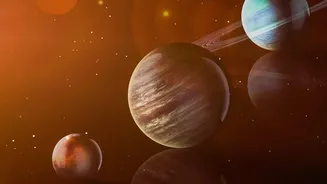
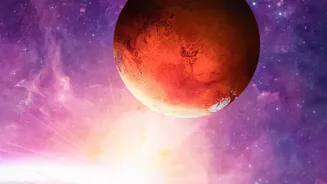
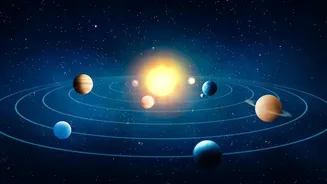
To understand the limits of this concept, we only need to look at our own cosmic backyard. Our solar system's habitable zone includes not just Earth, but also arguably Venus on its inner edge and Mars on its outer edge. Yet, these three worlds tell vastly different stories. Venus is a scorching hellscape with a crushing, toxic atmosphere and surface temperatures hot enough to melt lead. Mars is a frigid, low-pressure desert with a thin atmosphere that has mostly been stripped away. Only Earth is the vibrant, water-rich world we call home. This trio perfectly illustrates the headline's point: being in the right neighborhood doesn't guarantee a comfortable home. The habitable zone is a crucial first step, but it’s a blunt instrument that ignores the unique characteristics of the planets themselves.
The All-Important Atmosphere
Perhaps the most critical factor beyond location is a planet's atmosphere. An atmosphere acts like a blanket, trapping heat through the greenhouse effect and regulating the planet's temperature. Without it, even a perfectly placed planet would experience wild temperature swings between day and night. Venus’s runaway greenhouse effect shows what happens when you have too much of a good thing, while Mars's thin atmosphere shows the consequences of having too little. Furthermore, a planet's atmosphere provides a vital shield against the star's harsh radiation, which can strip away water and sterilize a surface. So, a planet not only needs to be in the zone, but it also needs to be massive enough to hold onto a substantial atmosphere that strikes a delicate, life-sustaining balance.
The Recipe for a True Habitable World
Beyond distance and atmosphere, the list of requirements for a truly habitable planet is long and complex. Scientists believe a protective magnetic field is essential to shield the atmosphere from being blown away by the stellar wind. The planet also needs the right mix of chemical ingredients—nutrients—to serve as the building blocks for life. The type of star matters immensely, too. Many common stars, like red dwarfs, are known for violent flare-ups of radiation, which could be disastrous for life on closely orbiting planets. Even a planet's geological activity plays a role; processes like plate tectonics, which are active on Earth, help regulate the climate over long timescales by recycling chemicals. A world could be in the perfect spot but be geologically dead, or orbit a volatile star, making it a poor candidate for life.
From Theory to Observation
For years, these factors were largely theoretical. But now, with powerful tools like the James Webb Space Telescope (JWST), we are moving from guessing to knowing. Astronomers are no longer just detecting planets in the habitable zone; they are beginning to analyze what’s in their atmospheres. The JWST can detect the chemical signatures of gases like water vapor, methane, and carbon dioxide. This allows scientists to determine if a rocky world in the habitable zone actually has an atmosphere and, if so, what it’s made of. These observations are already providing surprises and painting a much more detailed picture of these distant worlds. It's the difference between seeing a house from a distance and finally being able to peek through the windows to see if anyone is home.