



The Goldilocks Zone Revisited
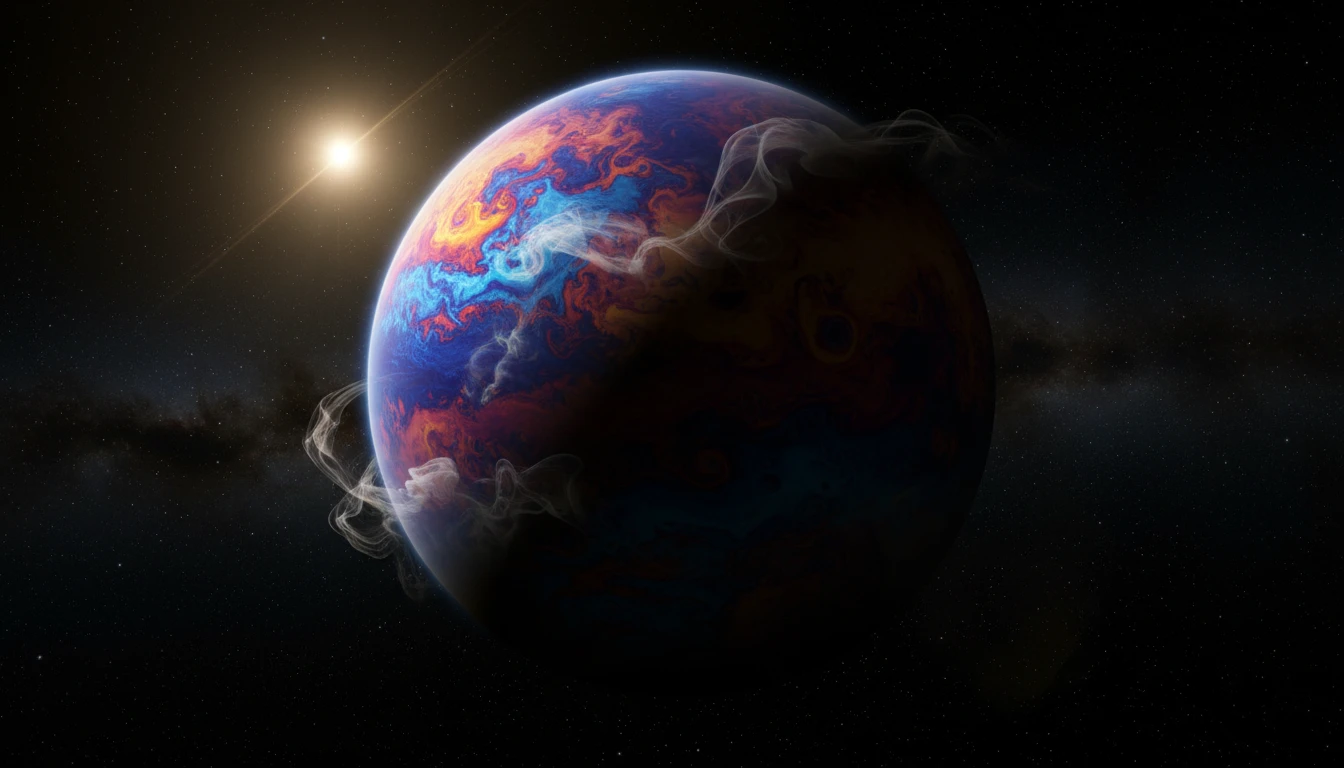
For decades, the search for habitable exoplanets has been guided by a simple concept: the “habitable zone,” nicknamed the Goldilocks Zone. This is the orbital range around a star where temperatures are just right—not too hot, not too cold—for liquid water
to exist on a planet’s surface. Finding a rocky planet in this zone was the first major step. The next, more exciting step, has been to analyze the atmospheres of these worlds. The holy grail has always been the detection of biosignatures—gases like oxygen or methane that could indicate biological processes. And, of course, detecting water vapour has been a primary goal, seen as a strong positive indicator for a world’s potential to host life.
A Steamy, Unexpected Complication
Powerful new instruments, most notably the James Webb Space Telescope (JWST), have revolutionized our ability to peer into the atmospheres of distant planets. These telescopes work by analyzing the starlight that filters through a planet's atmosphere as it transits, or passes in front of, its star. Different molecules absorb light at specific wavelengths, leaving a unique chemical fingerprint. JWST has successfully detected the distinct signature of water on multiple exoplanets, including gas giants. However, a complication has arisen. Water isn't just being found where we expected it. It is being detected in the upper atmospheric layers, or stratosphere, of gas giants—planets with no solid surface and crushing pressures below.
Not All Water Is Created Equal
This discovery forces a critical reassessment of what a water signature truly means. While water is essential for life as we know it, its presence in an atmosphere isn't an automatic sign of a habitable, ocean-covered world. Scientists now understand that water vapour in a planet's stratosphere can be a 'false positive' for surface habitability. This stratospheric water may not have come from a life-sustaining ocean below. Instead, it could be delivered from external sources, such as a constant bombardment by water-rich comets or asteroids. In this scenario, the water exists only in the high, thin atmosphere and has no connection to the planet's actual surface conditions, which for a gas giant, remain entirely inhospitable.
Recalibrating the Search Models
Because of these findings, habitability index models are becoming more sophisticated. Previously, a strong water signal from a planet in the habitable zone would have significantly boosted its habitability score. Now, astronomers must dig deeper. The new models must try to distinguish the source of the water. Is the spectral signature consistent with water vapour rising from a vast liquid ocean, a process that would make a planet a prime candidate for life? Or does the data point to a 'contaminated' upper atmosphere, where the water is merely a transient feature deposited from space? This adds a new layer of complexity, requiring more detailed analysis of atmospheric temperature, pressure, and the presence of other chemicals to build a complete picture.
A Smarter, More Focused Hunt
This might sound like a setback, but in reality, it marks a significant step forward. Science advances by refining its methods and understanding its blind spots. By learning to identify and filter out these misleading water signatures, astronomers can avoid wasting valuable observation time on worlds that are ultimately dead ends. This new understanding allows them to develop a more robust framework for identifying true biosignatures and deprioritize the false positives. It sharpens the focus of the search, ensuring that when we do point our most powerful telescopes at a distant world, we are looking at the most genuinely promising candidates for life.