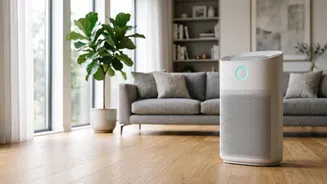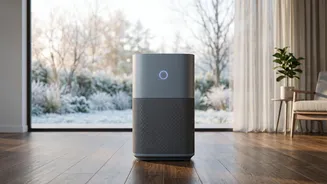







Start with CADR and Room Size
Before looking at any other feature, find the Clean Air Delivery Rate (CADR). This number tells you how much clean air the purifier delivers per hour. The higher the CADR, the faster it can clean a room. Matching CADR to your room size is the most critical
step. For a typical Indian bedroom of around 150 sq. ft., you should look for a CADR of at least 200-250 m³/h. For a larger living room (250-300 sq. ft.), a CADR of 350-450 m³/h or higher is more appropriate, especially during peak pollution seasons like winter smog or Diwali. Choosing a purifier with a CADR that's too low for your room means it will struggle to clean the air effectively, wasting electricity and offering little benefit.
Understand the Filtration System
An effective air purifier for India needs a multi-stage filtration system to tackle a complex mix of pollutants. The three essential components are the pre-filter, the HEPA filter, and the activated carbon filter. Pre-Filter: This is your first line of defence. It captures large particles like dust, pet hair, and lint. A washable pre-filter is a huge advantage in dusty Indian conditions as it protects the more expensive inner filters and is easy to maintain. HEPA Filter: This is the heart of the purifier. A 'True HEPA' filter is non-negotiable as it is designed to capture 99.97% of fine airborne particles as small as 0.3 microns. This includes the dangerous PM2.5 particles that are prevalent in Indian cities due to traffic, industry, and seasonal crop burning. * Activated Carbon Filter: While HEPA filters handle particles, they don't remove gases, odours, or Volatile Organic Compounds (VOCs). The activated carbon filter is crucial for adsorbing cooking fumes (like from tadka), smoke, and chemical smells common in urban homes.
Calculate the True Cost of Ownership
The price tag is just the beginning. The real cost of an air purifier includes ongoing expenses like filter replacements and electricity consumption. Filter life is a major factor. While manufacturers might state a filter life of one year, heavy pollution in Indian metros can clog filters in as little as six to eight months, especially if the unit runs continuously. Before buying, check the cost and availability of replacement filters. Some brands have filters that can cost several thousand rupees, making maintenance a significant long-term expense. Also, look for the power consumption rating (in watts). An energy-efficient model that runs for many hours on a low 'sleep' or 'auto' mode will be much lighter on your electricity bill.
Smart Features vs. Core Functionality
Modern purifiers come loaded with features like Wi-Fi connectivity, app controls, and real-time air quality index (AQI) displays. While an AQI sensor connected to an 'Auto Mode' can be very useful—allowing the purifier to adjust its fan speed based on the room's pollution level—other smart features can be considered 'good-to-haves' rather than essentials. Focus first on the core performance: a high CADR appropriate for your room and a robust three-stage filtration system. An app might be convenient, but it doesn't make the air any cleaner if the fundamental filtration capacity is lacking. Prioritise a machine that does the basics exceptionally well.
Don’t Forget Noise and Service
Two often-overlooked aspects are the noise level and after-sales service. If you plan to use the purifier in a bedroom, check its noise level, measured in decibels (dB), at the lowest fan setting. A quiet 'sleep mode' is essential for undisturbed rest. Look for models that operate below 30 dB on their lowest setting. Finally, check the brand's reputation for service in your city. Air purifiers are long-term appliances, and being able to easily buy replacement filters and get service if needed is crucial for ensuring the device remains effective for years to come.