





A Planet of Cosmic Contradictions
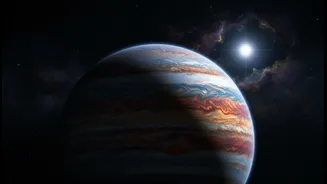
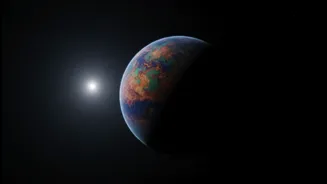
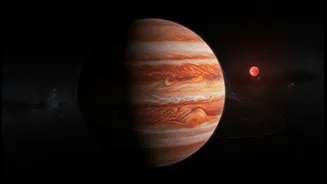
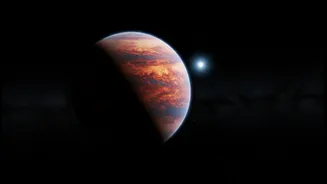
At first glance, WD 1856 b might seem familiar. It's a gas giant, roughly the size of Jupiter, located about 80 light-years away in the Draco constellation. But that’s where the similarities to our own cosmic neighbourhood end. The most striking thing
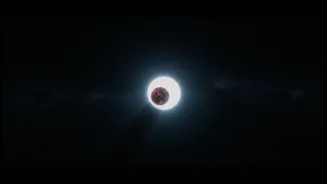
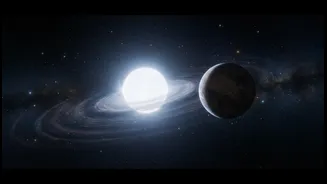
about this planet is its bizarre relationship with its star. In a stunning role reversal, the planet is about seven times larger than the star it orbits. It circles this tiny star at an astonishingly close distance, completing a full orbit in just 34 hours. By comparison, Mercury, our own solar system's innermost planet, takes 88 days to circle the Sun.
An Unlikely Host: The White Dwarf
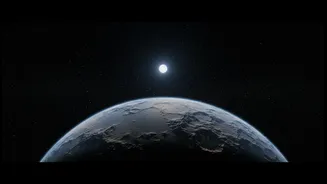
The star at the heart of this system, WD 1856+534, is no ordinary star. It is a white dwarf—the dense, Earth-sized core left behind after a Sun-like star exhausts its nuclear fuel and dies. Billions of years from now, our own Sun will suffer the same fate. Before collapsing into a white dwarf, a star like our Sun swells into a red giant, a phase of immense and destructive expansion. This process is expected to engulf and destroy any nearby planets. Mercury and Venus will be consumed by our Sun's red giant phase, and Earth may face the same fate. This is why finding a planet, especially a giant one, snuggled up so close to a white dwarf is a profound puzzle.
The Survival Paradox
This brings us to the central mystery of WD 1856 b: how did it survive? Based on our understanding of stellar evolution, its current orbit places it well within the zone that would have been engulfed by its star during the red giant phase. It should have been obliterated. The discovery of this intact planet in such a tight orbit was a major shock to astronomers when it was first identified in 2020. It represented the first time an intact planet had been found orbiting so closely to a white dwarf, challenging long-held theories about the end-of-life stages of planetary systems. It's a cosmic survivor against all odds, a planet that is forcing a rewrite of astronomical textbooks.
A Story of Migration
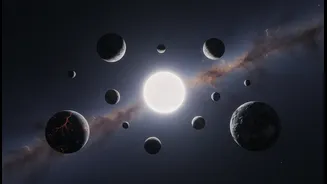
So, if it couldn't have survived in its current orbit, how did it get there? The leading theory is that WD 1856 b is a cosmic migrant. Scientists believe the planet formed much farther away from its star, in a safer, wider orbit. It remained there for billions of years, safely weathering the star's violent transition from a red giant to a white dwarf. Only much later, long after the star had settled into its quiet retirement as a white dwarf, did the planet begin its journey inward. This migration may have been triggered by the gravitational nudges from other bodies in the system. The white dwarf is part of a triple-star system, and the gravitational pull of the two distant companion stars could have been enough to destabilize WD 1856 b's orbit and send it spiraling toward its current, close-in position.
A Glimpse into Our Solar System's Future
Studying WD 1856 b is more than just solving a cosmic puzzle; it's like looking into a crystal ball for our own solar system. Our Sun will also become a white dwarf in about five billion years, and the fate of Jupiter, Saturn, and the other outer planets is a subject of intense scientific interest. By analyzing the atmosphere of WD 1856 b with powerful tools like the James Webb Space Telescope, astronomers have detected methane and haze. They've also found that the planet is much warmer than expected, likely residual heat from its dramatic inward migration. This 'life after death' system demonstrates that planets can not only survive their star's demise but can also have dynamic, evolving futures for billions of years afterward.